
PART 1
Where our leads come from.
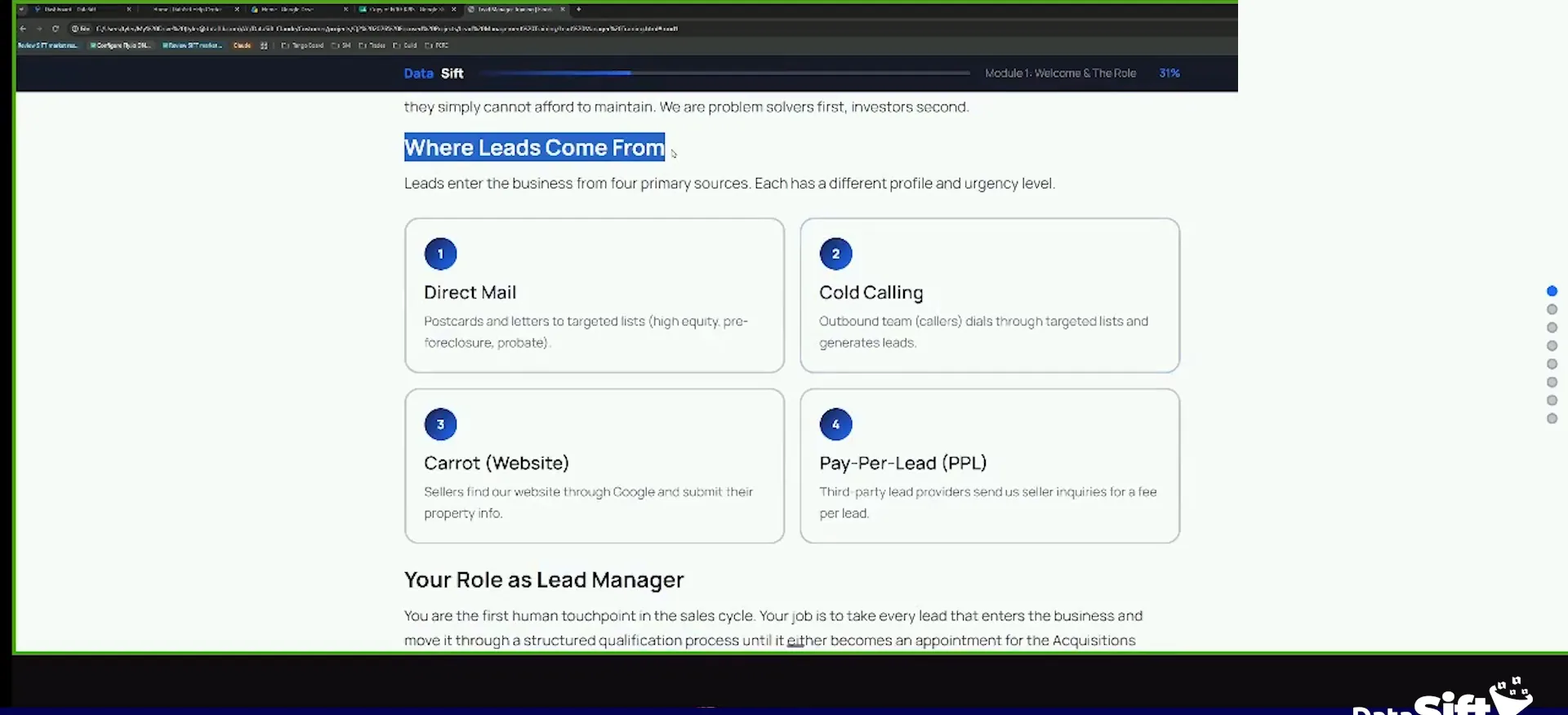
Leads enter the business from four primary sources. Each one has a different profile and a different urgency level. If you are lead managing, you need to know all four before you touch a single record.
The four sources.
Learn all four places a lead can come from.
The next thing that's really important for a lead manager to know is where do the leads come from. If I'm lead managing in a business, I need to know where these people are coming from.
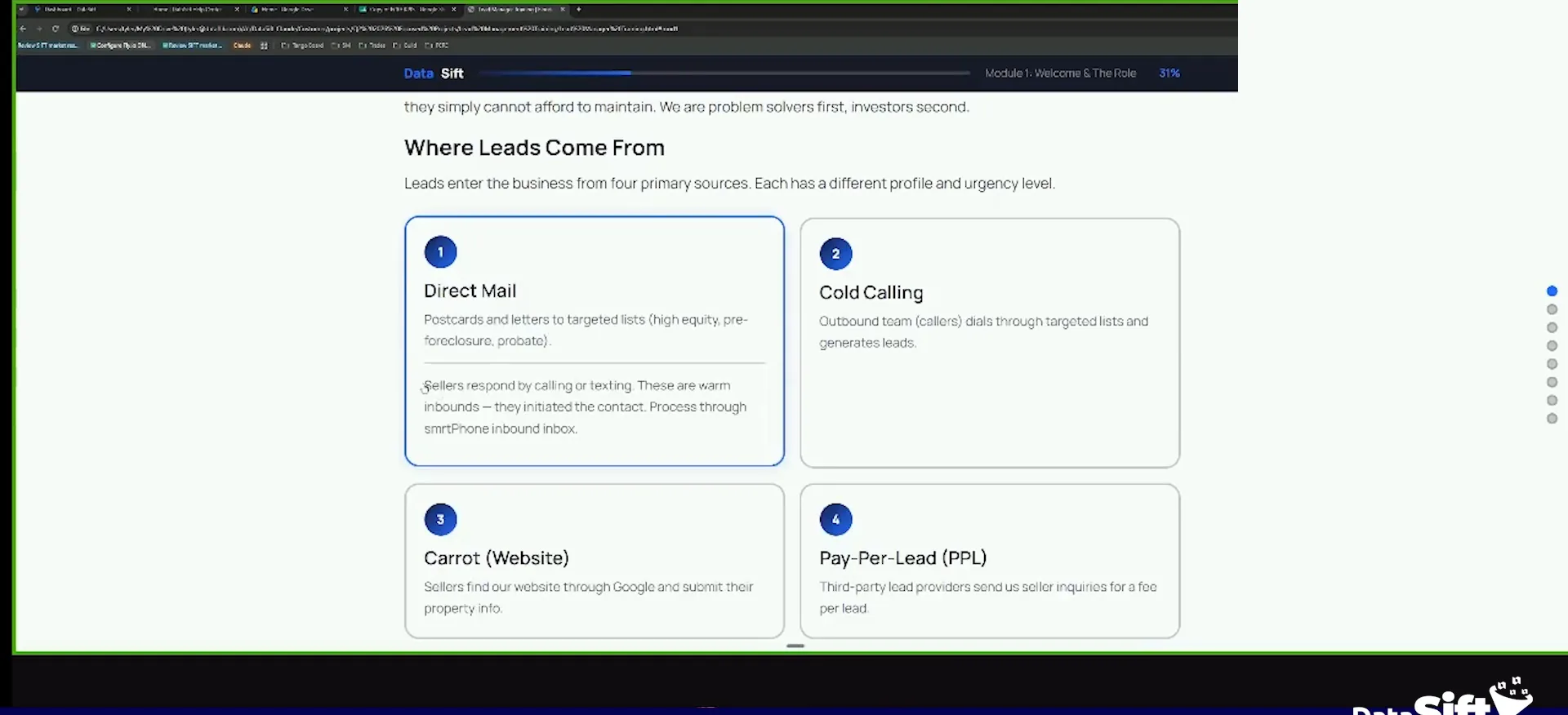
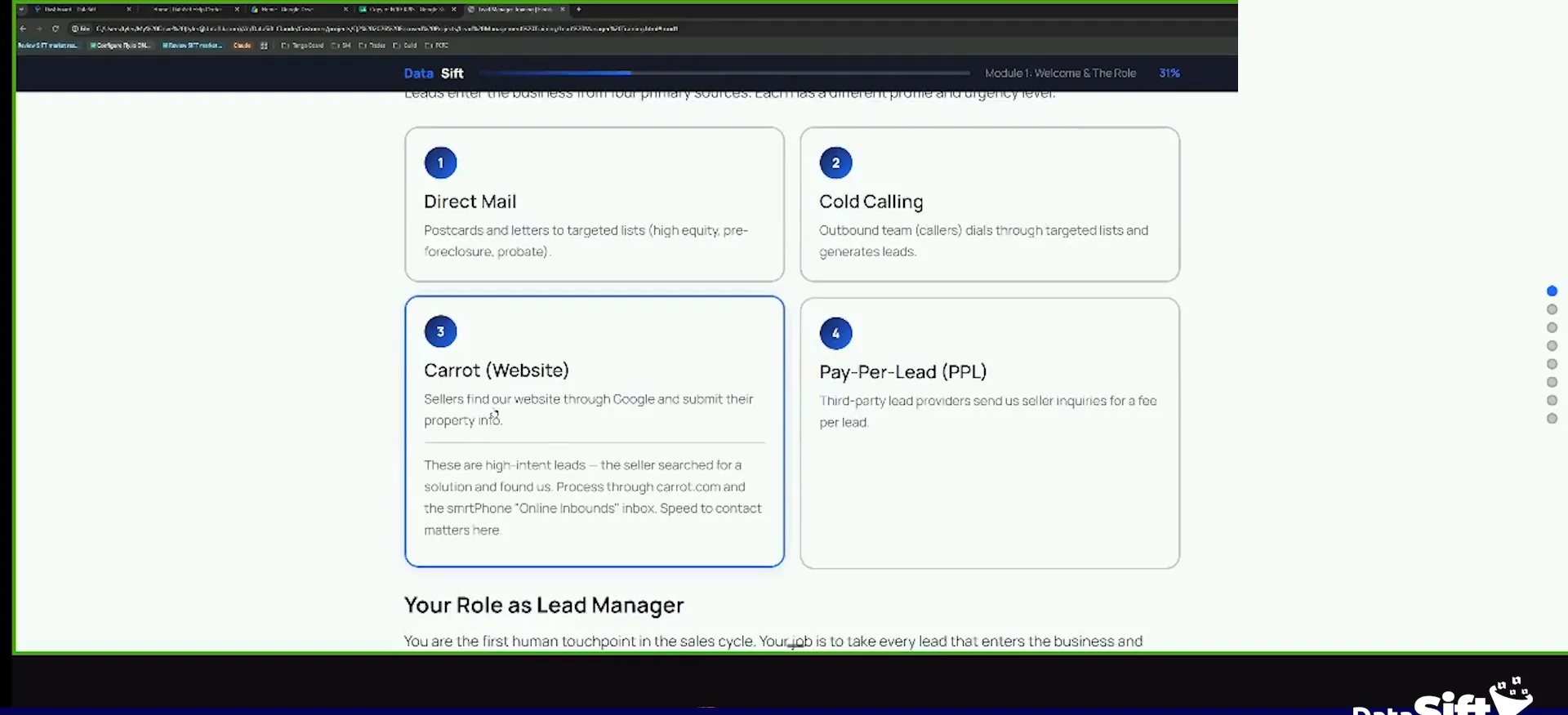
For us it is four primary sources. Direct mail, cold calling, our Carrot website, and pay-per-lead. If you click on any one of these, it gives more details.
So if I'm lead managing in a business, I need to know where the heck are these things where are these people coming?
Check the direct mail inbox first every morning.
Direct mail is postcards and letters to a targeted list, whether it be high equity, pre foreclosure, or probate. Sellers respond by calling or texting. These are warm inbounds, because they started the contact.
In our smartphone account, and in pretty much every dialer you would ever use, you can point a phone number at an inbox. So we have a direct mail inbox. Our team processes those calls first.
In the morning time, our team looks at that inbox to see, was there any text message or any phone calls to that inbox?
Verify motivation on every cold call lead.
Cold calling is the outbound team. Callers dial through a targeted list and generate leads, so these are outbound generated. Quality varies here, so you need to verify motivation yourself.
The Carrot website is the other end of that. Sellers find us through Google and submit their property information, so these are high intent leads. Speed to contact matters. Calls route to our online inbounds inbox and ring your phone, and form submissions come through Zapier.
The cold caller had a conversation and determined the seller might be interested, they push the record to you as a new lead.
We just go to the source.
Open carrot.com yourself instead of trusting the sync.
Say there was an inbound lead last night. I don't want to assume that Zapier worked. I don't want to assume that the webhooks worked.
So instead, we just go to the source. We go to carrot.com and we look, was there any new leads. If there is, we go to the Sift and we process the lead. If we had a phone call from the website, we call those back.
Some people say they only look in their CRM for these things. I believe in going to the source of truth as much as possible. Carrot is the source for inbounds, so I want my lead manager in there.
Check your pay-per-lead provider site for new leads.
Zapier connects all the pay-per-lead providers. We use property leads when we are paying for pay-per-lead. There's a bunch of them out there, that is just the only one I have personally used.
So we open propertyleads.com and check, was there any new leads since last night. If there was, we copy the address, go to the CRM, paste the address, and work the records.
I also want my pay-per-lead inbounds. With property leads, if someone calls the number on the landing page, it redirects to you once you bought the lead. I get calls that look like property leads calling me, and it is a handoff from that landing page number.
Most likely, it's already under there for tasks that are due, but I just don't wanna assume that, webhooks and APIs all work there.
Your role as a lead manager.
Teach your team how leads enter the business.
That inbox may have missed phone calls on it. When we talk to leads, we mostly use the direct mail number, the pay-per-lead number, and our Carrot website number.
So put in whatever sources you are using. A lead manager is the line of defense between marketing and acquisitions. If they don't know how leads are generated, they can't give marketing feedback when something is wrong.
And if your lead manager doesn't understand how leads are generated, how are they supposed to give feedback to marketing if something's wrong?
The handoff
The lead manager sits between marketing and acquisitions.
- 1Marketing generates leadsThis is where the leads come from, and your team has to understand how they are generated.
- 2Lead manager, first human touch pointYou move every lead through a structured qualification process until it becomes an appointment or exits the pipeline.
- 3Acquisitions makes offersYou need to know the opener of the acquisition conversation so you can set that person up for success.
Learn the opener of the acquisition conversation.
In any role, people need to understand the position before them and the position after them. At least the 15% before and after.
So if a lead manager is handing something off to acquisitions, they need to know what the opener of the sales conversation is. Not all the underwriting, just enough to know what happens next. The more we make sure there's good handoffs, the more successful our business can be.
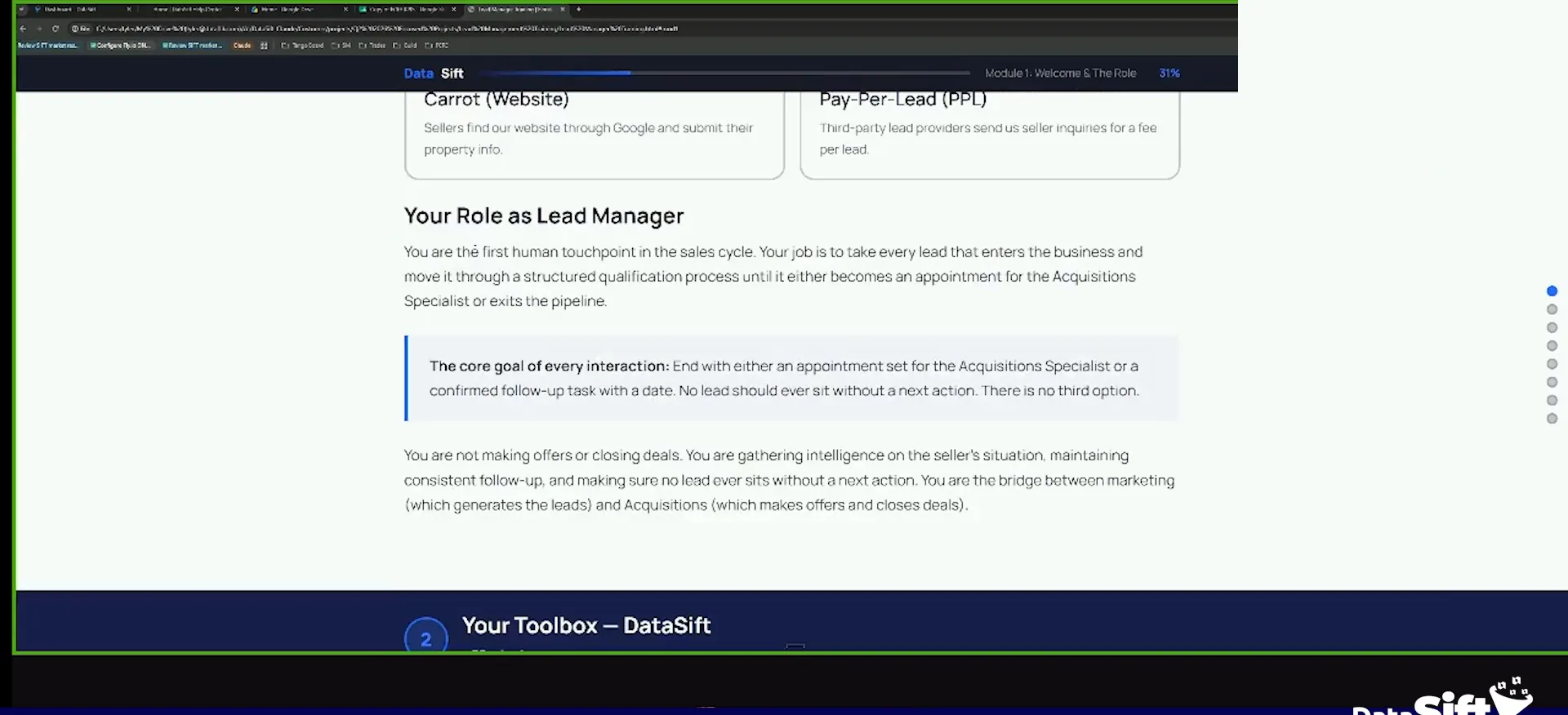
Your job is to take every lead that enters the business and move it through a structured qualification process. It either becomes an appointment for the acquisition specialist, or it exits the pipeline. As a lead manager, I am continuing to nurture.
Keep acquisitions out of lead management.
Be very careful on this one. It's okay to have a lead manager that does acquisition offers. It is not okay to have an acquisitions person that does lead management.
So your role as a lead manager, you are the first human touch point in the sales cycle.
BEFORE YOU MOVE ON
PART 2
Who does what with the lead.
Part 1 covered where leads come from and what your job is. Now I want to split the roles apart, because mixing them up is how deals get lost. Your lead manager gathers the intelligence, and your acquisitions person creates the deal.
Acquisitions should not nurture leads.
Keep your acquisitions person out of lead nurturing.
If you already have a lead manager in your business, you do not want your acquisitions person nurturing leads. They are a deal creator. They are acquisition specialists.
Think of it like buying a vehicle from a car dealership. Once the contract is signed, you go talk to the finance manager to do all the paperwork. That finance manager is your acquisitions person. They are supposed to be way more sophisticated about transactions and deals.
And what I mean by that is if you already have a lead manager in your business, you do not want your acquisitions person nurturing leads.
Two roles
The two roles do different work on a lead.
Lead manager
- Nurtures the leadsYes
- Creates the dealHands it off
- Only makes 70% ARV offersNo
Acquisitions specialist
- Nurtures the leadsNo
- Creates the dealDeal creator
- Only makes 70% ARV offersNo, knows all the options
Hire a specialist, not a sales floor.
They are not supposed to be someone who just does 70% ARV and makes an offer. They need to understand all the options. They need to look at the seller and see what is going on in their life, and what equity they have.
That is why a lot of really great acquisitions people are lead managers who got really good at talking to sellers. If you are only marketing to a ton of high equity properties, sure, have a sales floor. What I highly recommend instead is having a specialist, because your business is so much less stressful.
Your lead manager is a relationships person.
Pull the emotion and the situation out of the seller.
I am not saying you never ring a bell or celebrate a contract. Ring the bell, you got a contract. But your lead manager is a relationships person.
They understand the psychology of pulling information and emotion from the seller. What is the driving force to make a decision today. What is going on in their life, and what do they truly care about.
Relay what you learned so acquisitions can offer right.
The lead manager relays that information effectively so acquisitions can make the right initial offering. You steer the seller toward the best solution for them, and the one that is also the best solution for us. And if we cannot help, then we cannot help, and we just say that.
Novation is a great example. The property is in beautiful condition, it does not need probate, it could be listed right now and sell. The seller just wants their price, and they are tired of the property.
You're gonna walk away with that, and all you gotta do is sign the paperwork, and then we'll go ahead and take care of everything else.
You cannot change a core belief system.
Stop trying to reprogram how the seller thinks.
So we can do our white glove listing service. We list the property for around 250,000, we take responsibility for the fees, we pay the realtor, and the seller still gets their 200,000. The other option is we just list it for them for 250,000 and only make our commission.
A lot of acquisitions people and a lot of lead managers try to reprogram the way the seller is thinking. They have been thinking that way for fifty or sixty or seventy years. The only way to change that is with sales processes I would not consider very ethical.
End every conversation with an appointment or a dated task.
There is no third option. There is always somewhere the lead belongs. That can be staying exactly where it is with a next task added, or moving to another phase.
If it has a status that belongs in our sales pipeline, there is always a task on it. It should never not have a task. This is how you lose deals.
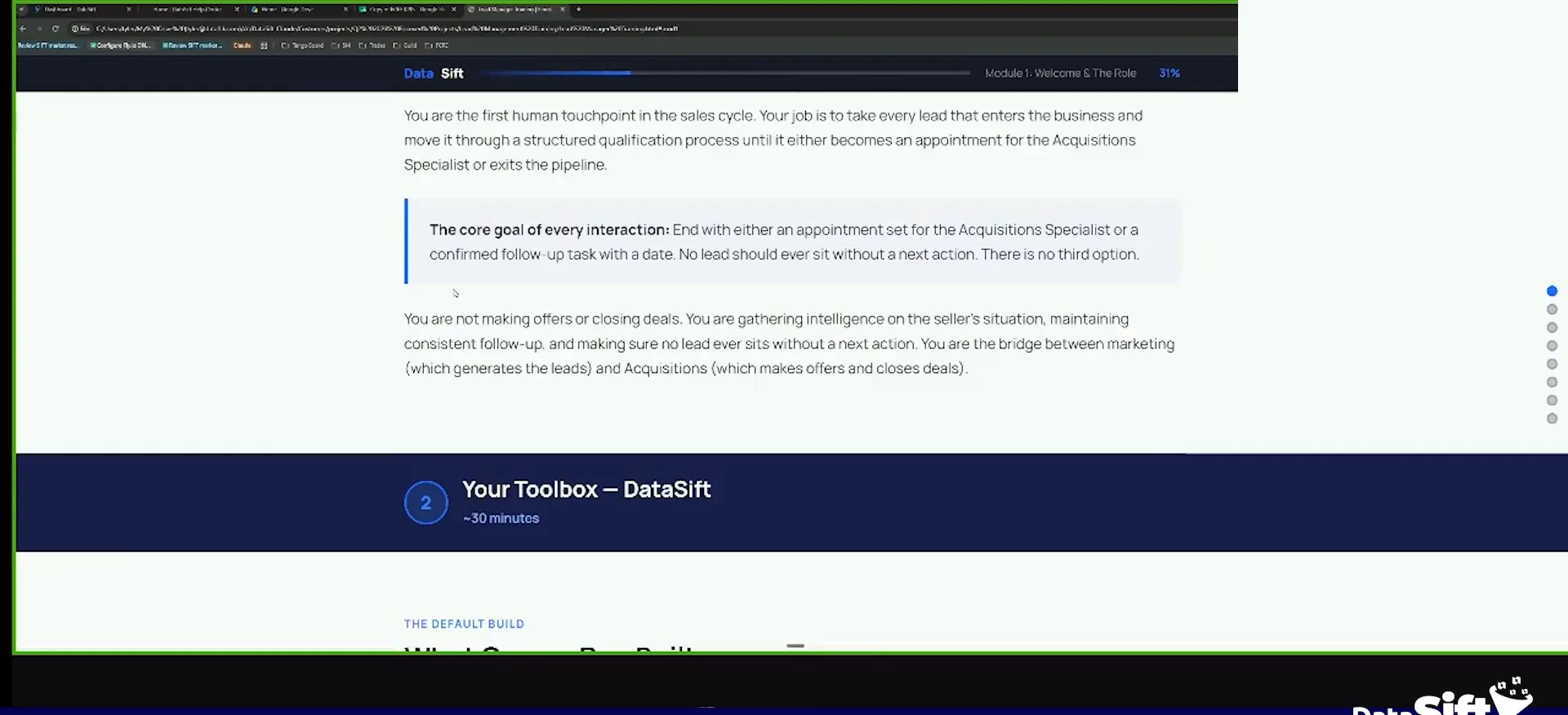
So, the core goal of every interaction is to enter with either a appointment set for the acquisition specialist or a confirmed follow-up task with a date.
The core goal
Enter with either an appointment set for the acquisition specialist or a confirmed follow-up task with a date. No lead should ever sit without a next action, and there is no third option.
Work as the bridge between marketing and acquisitions.
You are not making offers or closing deals. You are gathering intelligence on the seller situation and keeping follow-up consistent. Marketing generates the leads and acquisitions makes the offers, and you sit in between.
BEFORE YOU MOVE ON