
PART 1
The unqualified phase, daily then weekly.
A lead who does not pick up the phone becomes a no contact new lead. That sits under the unqualified phase, and it runs on two different tempos. Part 1 covers the naming, the two tasks, and the touches you stack over six months.
What this lesson covers.
Walk through the unqualified phase and the nurturing process.
In this lesson we go over everything that has to do with the unqualified phase and the actual nurturing process of an entire lead. We also go over what is a qualified versus an unqualified lead from our own perspective.
This one is a clip from the challenge itself.
in this lesson, we're gonna be going over everything that has to do with the unqualified phase and the actual nurturing process of an entire lead.
No contact new lead means unqualified.
Name the status no contact new lead.
If they do not pick up, they are now a no contact new lead, and that sits under your unqualified phase. The status of the record says no contact new lead, not unqualified. I want the name of the status to line up with what actually happened.
It is easier to remember that no contact new lead means unqualified than the other way around. They mean the same thing. I ran a poll in the community and this wording was clearer to everybody.
it's easier to remember that no contact new lead means unqualified than remembering that unqualified means you haven't got on the phone with him yet.
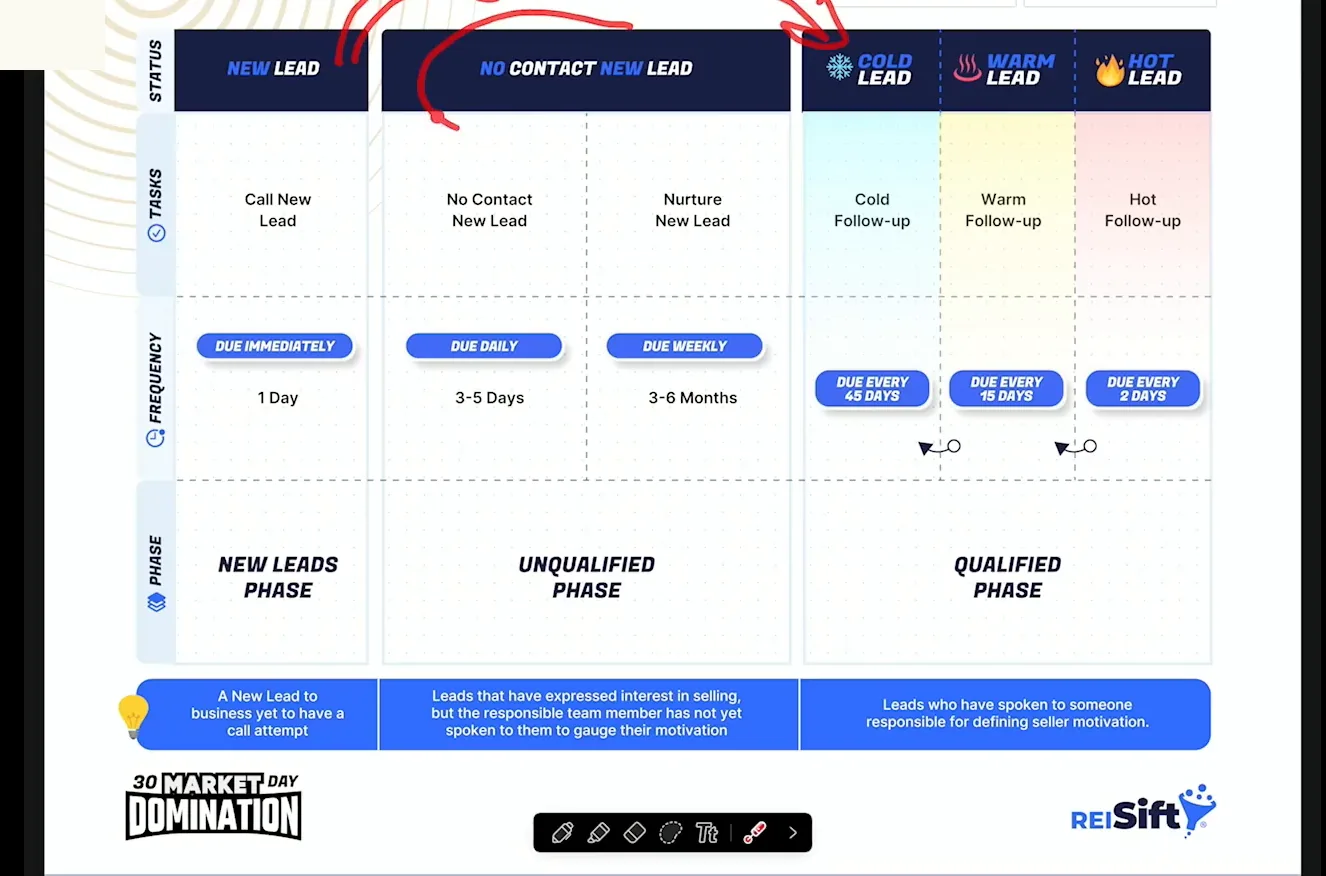
Split the phase into two tasks and two frequencies.
Not all leads are created equal. We do not want to call every single lead that comes into the business every single day forever. The property might be in the middle of nowhere, in a location you do not love, and not something you could sell or flip easily.
So you say, I do not want to call that guy every day, I want to call him every week. You still want to qualify him, because it might be a deal. It just does not deserve the same attention as a lead in the inner city or an infill lot you know sells easily.
The first section of part one gets the no contact new lead task, the same name as the status. When a lead enters that phase they are due daily, and you leave them there for three to five days.
The status stays three to five days.
Look at the record and decide weekly or daily.
The status is going to stay there for three to five days. If the person does not pick up the phone in that window, you hit a junction. You have to look at the record and make a call.
There is no right or wrong answer there. When you move someone to weekly, you are probably only going to call them upwards of three months on the weekly cadence.
Do I want to consider this person, move them to a nurture, which is going to be a weekly follow-up? Or do I want to leave them in here and continue just calling them every single day?
Add up the touches you get over six months.
Say I keep calling every single day. Then I move them to the next stage of the unqualified phase and leave them in there for the whole six months. I keep calling because I really want to get them on the phone. It might be the thirty fifth touch before this person picks up.
Here is the math he walks through. I would have five touches on the daily side. Then, calling every single week for six months, that is four times six, plus five. It was right around thirty two or something like that, total touches on that person.
That is what this really comes down to, how many touches happen up to that six month period of a record being in your business.
Keep following up after you move them to ghosting.
Even if we move those people to ghosting, we are still following up. That happens every forty five to ninety days also.
So the record does not go quiet on you. It just moves to a slower tempo.
BEFORE YOU MOVE ON
PART 2
Ghosting, tempo and the record.
We are not going to stop following up with anybody. We just change how often we call, and ghosting is where the slowest calls live. Then I go into the account and show you what one status change does.
I never stop following up.
Move the lead to ghosting instead of stopping.
When I move someone out of part two of this unqualified phase, I move them to ghosting. That will make sense once I show it to you. I never stop following up.
They are still technically unqualified. Ghosting can be a mixture of people from no contact new lead, or from cold, warm or hot.
I'll move them to ghosting and I'll do a campaign still every forty five days against those individuals.
Qualify the lead and set cold, warm or hot.
Say someone picks up the phone, maybe right away under new lead, maybe at some point in no contact new lead. You qualify them and move them to cold, warm or hot. Your business decides what cold, warm and hot mean.
A cold lead gets a task called cold follow-up, due every forty five days, and we keep calling every forty five days. You might double tap them on those days, morning or evening. If it goes from cold to warm, that becomes every fifteen days, and warm to hot is every two days.
Tempo by status
Each status has its own frequency.
Change the task date when they name a day.
Say you call and they pick up and say, yeah, whatever, call me in thirty days. You still apply the cold follow-up task. You just change the date to thirty days out, because by default it lands on forty five days.
If someone jumps straight to hot, seems super motivated, then stops answering, I move them from that two day tempo to every fifteen days. In your business you might leave them there for two months or so. If you still cannot get them on the phone, move them to the forty five day tempo.
Tempo is the lead manager's job.
Call every two days when the auction is close.
Sometimes the person is not communicating well, but it is a foreclosure going to auction in thirty days. You do not want that one under forty five days. Your tempo needs to be every two days so you do the most effort you can to reach them.
The common sense move as a lead manager is to keep calling them daily and leave them under the no contact phase. Or if I qualified them and they stopped picking up, I put them back where I have to reach them. I want the tempo of the task to be what I choose.
They're extra hot when they want to sell for you but it's all about tempo and frequency as a lead manager and when we need to follow-up.
Split unqualified and qualified by who has spoken.
The unqualified phase is leads who have expressed interest in selling, where the responsible team member has not yet spoken to them to gauge motivation. The qualified phase is leads who have spoken to someone responsible for defining seller motivation. That is the line between the two.
A lot of people think a hot lead is someone who is going to sell me their house today. No. A hot lead is a lead that is communicating with you and says they want to sell their house.
To summarize, we have three phases, new leads, unqualified and qualified. Inside those phases a record carries a status. New leads only have a new lead status, and the unqualified record status is no contact new lead.
Two phases
The two phases split on motivation.
Unqualified phase
- Who is in it?Expressed interest in selling
- Has motivation been gauged?Not yet
- What is the status?No contact new lead
Qualified phase
- Who is in it?Have spoken to someone responsible
- Has motivation been gauged?Yes, motivation defined
- What is the status?Cold, warm or hot
Change the status and check the record.
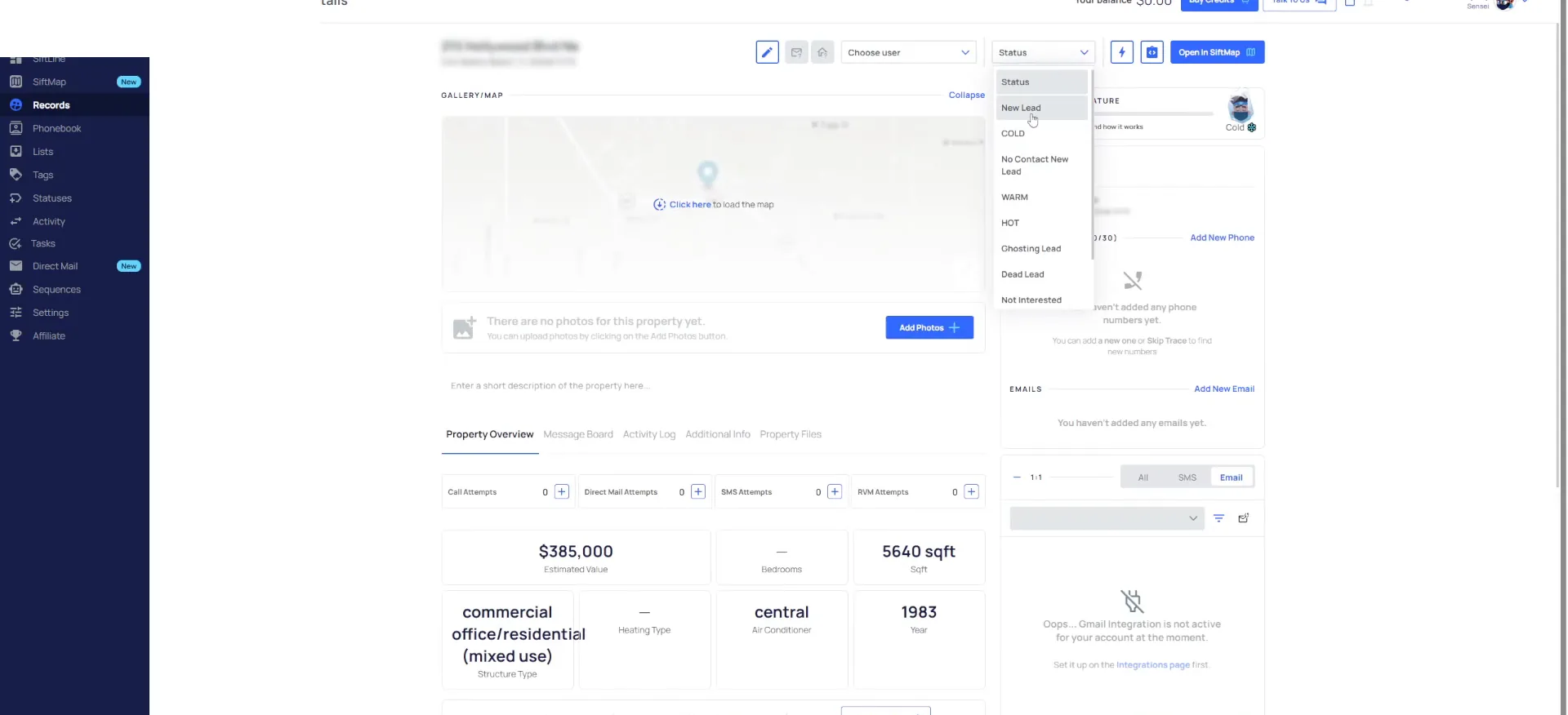
Select the record and change the status to new lead.
Once you qualify them and get them on the phone, you figure out when they want to sell or sign. Then you move them to the cold, warm or hot phase in your Sifline board. That automatically adds those tasks with the respective frequencies.
So let's go over to Sift and look at our account. I select this record and change the status to new lead. No different than if my team member did it, or if it came inbound from Zapier via a Carrot website.
Check status, tasks, boards and messages on every record.
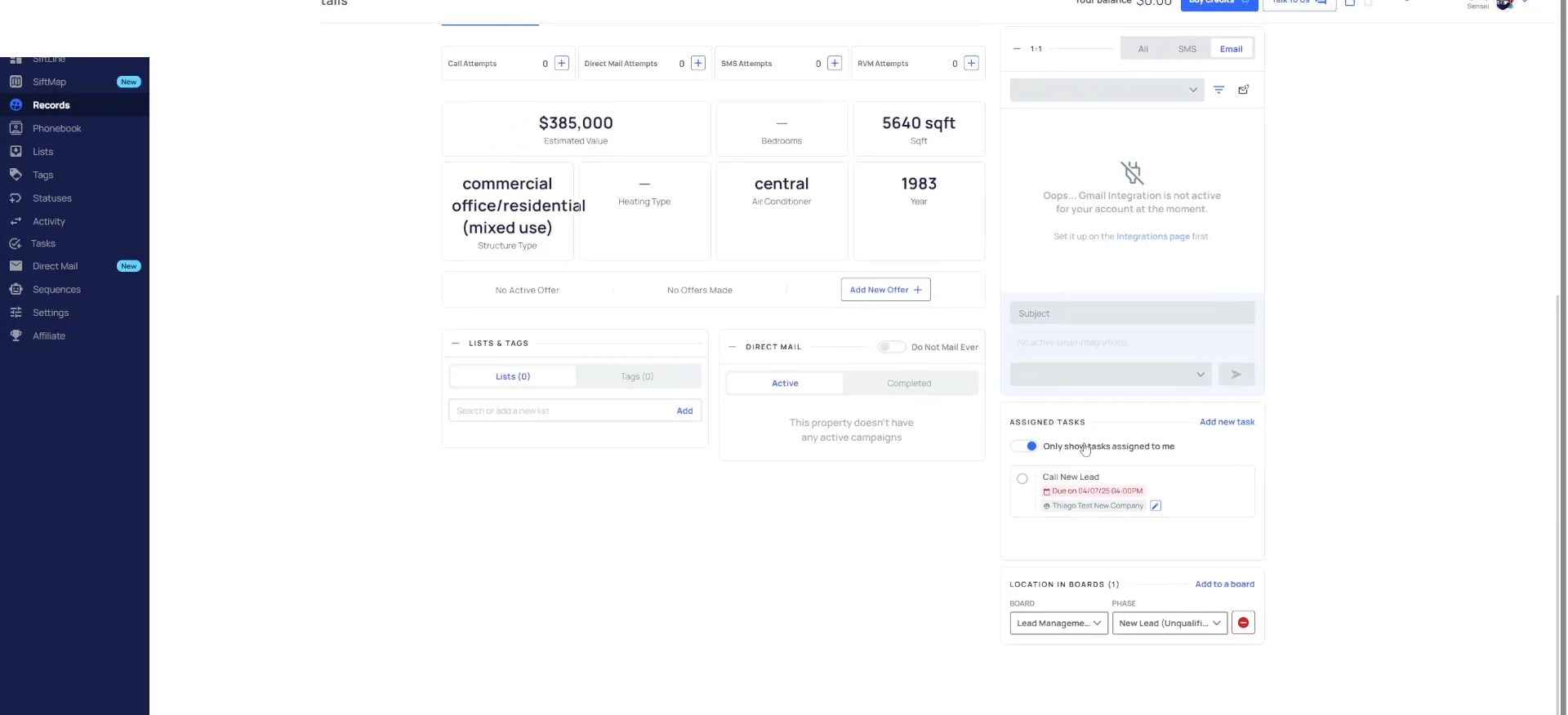
Look at the record now and you can see it is purple and says new lead. You can change these colors, I just chose the ones I prefer for default accounts. Changing the status moved it to our Sifline board and added a task, and that task came in overdue.
Anytime you go to a record as a lead manager, or anybody else in your business, I recommend the acronym STABEM. Status, tasks, boards, messages. A new lead status should have a call new lead task, and it should sit under lead management, new lead, unqualified phase. I should not have any messages yet unless my caller left some.
Anytime you go to a record as a lead manager or anybody else in your business, I always recommend the acronym STABEM.
BEFORE YOU MOVE ON