
PART 1
Your VAs and your prospectors.
This part covers the people side of the business, from VAs to prospectors. I also cover how we manage them without watching their screens. The rules are KPIs and a calling window, and that is about it.
The order you hire people.
Hire your VAs and prospectors in the right order.
Everything from your VAs to your prospectors to all the different people that you actually need to have the best business possible. And the order of which you should actually hire those people.
So that is what I walk through here, person by person.
This is the entire process of breaking that down.
Open and goal management.
Give prospectors KPIs instead of tracked hours.
We do not actually measure how long they are on. We just say, hey, these are the KPIs we kind of expect from you, and we do an open and goal management model.
We kind of feel like stupid rules about the hours you have to be on are a bad sign. If you need them, you probably hired wrong in the first place.
The KPI we give them is 250 dials and texts per week. We do a 150 plus dials per day, and a lot of them will hit 200.
Hold them to one to four opportunities a day.
From there, we expect one to four leads, or one to four opportunities a day is what we would say. That is the output we read, not the hours.
We do not work Saturday and Sunday. I think there is a play to be had with them doing Saturdays. A ton of people do it with a lot of success.
We just haven't gotten there Rami really likes the idea of, having a evening team and a morning team and, having them kinda alternate Saturdays.
Open and goal
The KPIs we expect every week.
They must be calling within our time zone, nine to seven eastern.
Make them call inside your time zone only.
They must be calling within our time zone so they do not upset sellers, from a legal perspective. That is usually 9AM to 7PM eastern, depending on how the day goes.
Inside that window, I do not care when they are on. One of them has a newborn, so we are not going to ask why they are off in the middle of the day. Throughout that whole day, their roles are getting done.
My biggest fault as an operator is not firing faster than I should. So I read the report, and I could be a lot better in this kind of world.
BEFORE YOU MOVE ON
PART 2
Core values, pay, and who gets what data.
This half is about how the people get managed once they are in the seats. I hire and fire on core values, not on one missed task. Then I decide who gets the good data and who starts on the rest.
We hire and fire by core values.
Write your core values before you hire anyone.
I believe in first setting core values, and we hire and fire by those core values. Ours are on a graphic I keep in Slack. It says will the impossible, enjoy the moments, lend a hand, show up, and value in everything.
The best advice I can give is to set the things that matter the most to you as an operator. Then fire based off people not doing those things.
we try enormously diff enormously overkill in terms is kind of expected of us, and I expect the rest of our team to do that.
Judge people on the values, not one missed task.
Get shit done is one of ours. Say we give you a task with a date on it. If that just does not happen, that is not getting shit done.
Lending a hand is the other side of it. Mason called a person over the weekend just to help him out. He did not have to do that.
Those intangibles are much harder to measure, and that only comes with experience.
It's much easier to do that than to say, this person, didn't do their work because it's a lot more than, they didn't do their work.
Core values
The values we hire and fire by.
Put every new hire on a ninety day trial.
Someone asked if I give them a week to try out. No, we do ninety day trials. We see how they perform, and we say out loud what good looks like.
Then you watch for the leading indicators, like them not doing their work. Do not overthink it. Just keep the values in mind while you watch.
We're just gonna see how you perform in the first ninety days and kinda set expectations of what, good looks like and, align all that stuff.
The traditional model is consolidating.
Pay a closer a base plus commission on profit.
The closer in this case would be the $2,000 base. It has to be higher if you are in California, but that is kind of the bare minimum.
Door knocking is not something we do, but I have friends who do it and that is about the cost for it. How you verify they actually went out is a whole process, and I will show that in the next cohort.
And then that can creep up depending how good they are, and then you pay a 10% commission based off close projected profit.
Closer pay
A closer costs a base plus commission.
Expect the prospector and lead manager to become one seat.
On the org chart there is a cold caller, a lead manager, and a closer. That traditional model is someone to call, someone to manage the leads, and someone to close them.
I am not saying it has to be that way, because we are not doing it that way yet. I just think that is where the industry is headed.
I think the lead manager and the prospector or the cold caller are gonna be the same person probably for us going forward.
Assign each person a set of lists off doors per deal.
Here is a good example. Pull up doors per deal and look at the lists ranked out. You can hand one person a block of that data and put a team on the next block.
That is how the consolidated seat still stays manageable. The person owns the data, not a vague job title.
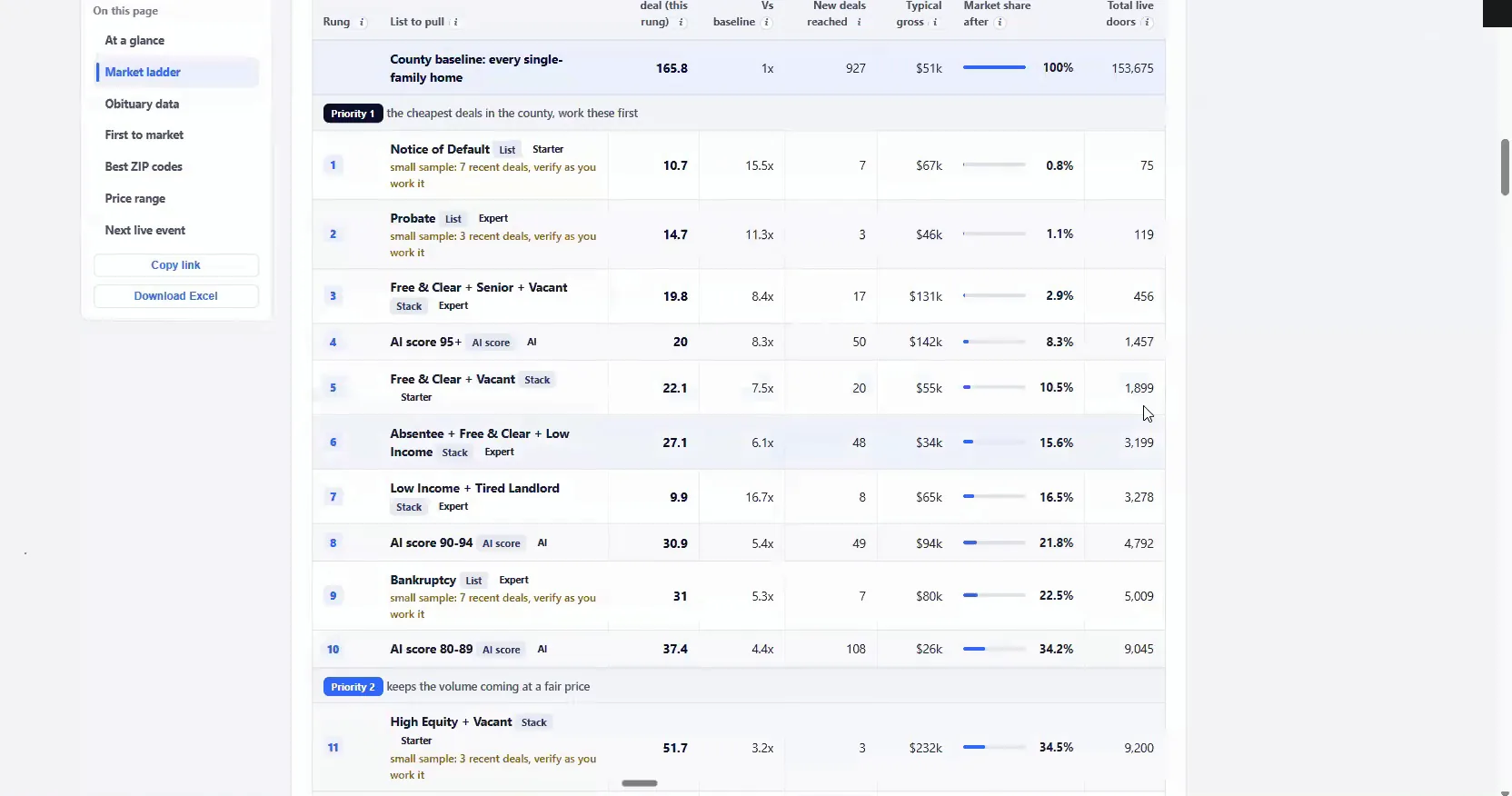
Best team members get the best data.
Give your best team members the best data.
Our best team members are going to be getting the best data to work with. New people start with the lesser data to get acclimated, then we gradually scale them up.
We do not want to give a new hire PPC leads. That would be silly, because we pay a lot of money for those. This is the equivalent of that idea, applied to lists.
And depending how good each of them are, almost like lead scoring lead score this is advanced.
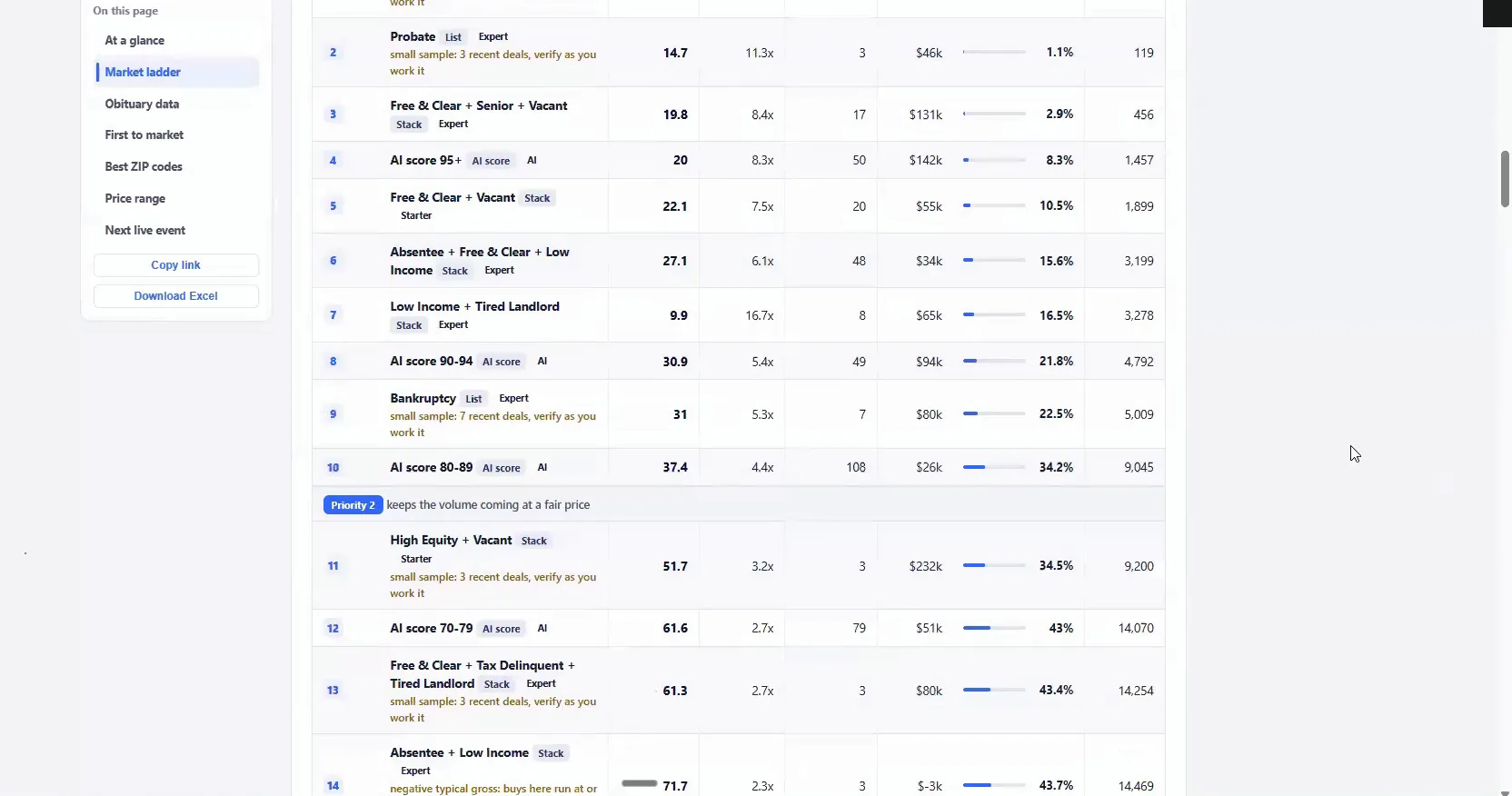
Pay overseas team members through Wise.
Wise is probably the industry leader. We also use a tool called Deel, d e e l, but that is more for larger companies. It is about protecting IP and legal stuff, and most people will not need it.
You can pay pretty much anything biweekly. For the stateside folks we use Augusto.
Paying the team
How we pay overseas and stateside people.
- 1Overseas through WiseWise is probably the industry leader, and you can do pretty much anything biweekly.
- 2Stateside through AugustoFor the stateside folks we use Augusto.
- 3Deel for larger companiesThat one is more for protecting IP and legal stuff, and most people won't need it.
Give prospectors some inbound leads to protect morale.
I feel pretty strongly that the closer is just getting live transferred opportunities, or going out for appointments. That person gets the walk throughs and walks people through the offer process. Everything else consolidates into one person.
This is my opinion, so no pitchforks. If someone spends half the day prospecting, give them some inbound leads too, from mail, meta, or PPC. Splitting the day up keeps them from getting burnt out.
BEFORE YOU MOVE ON