
PART 1
How a record moves.
I want to explain the three different phases and then the breakdown of a lead flow. This is what a record experiences from a lead management perspective. Start with the four pieces, then watch one record move.
The four parts of lead management.
Learn the four parts before you touch a record.
When it comes to our lead management, it is broken down into four things. Status, that is the status of the record. Tasks, which is the thing that we need to complete on a record.
Then frequency, which is the tempo of which those tasks are due and how long we do them for. Those three ride along with every record you work.
Frequency, which is the tempo of which those tasks are due and how long we do them for.
Lead management
Lead management is broken down into four things.
- 1StatusThat's the status of the record.
- 2TasksThe thing that we need to complete on a record.
- 3FrequencyThe tempo of which those tasks are due and how long we do them for.
- 4PhasePhases are the overall, where in the sales cycle is a record.
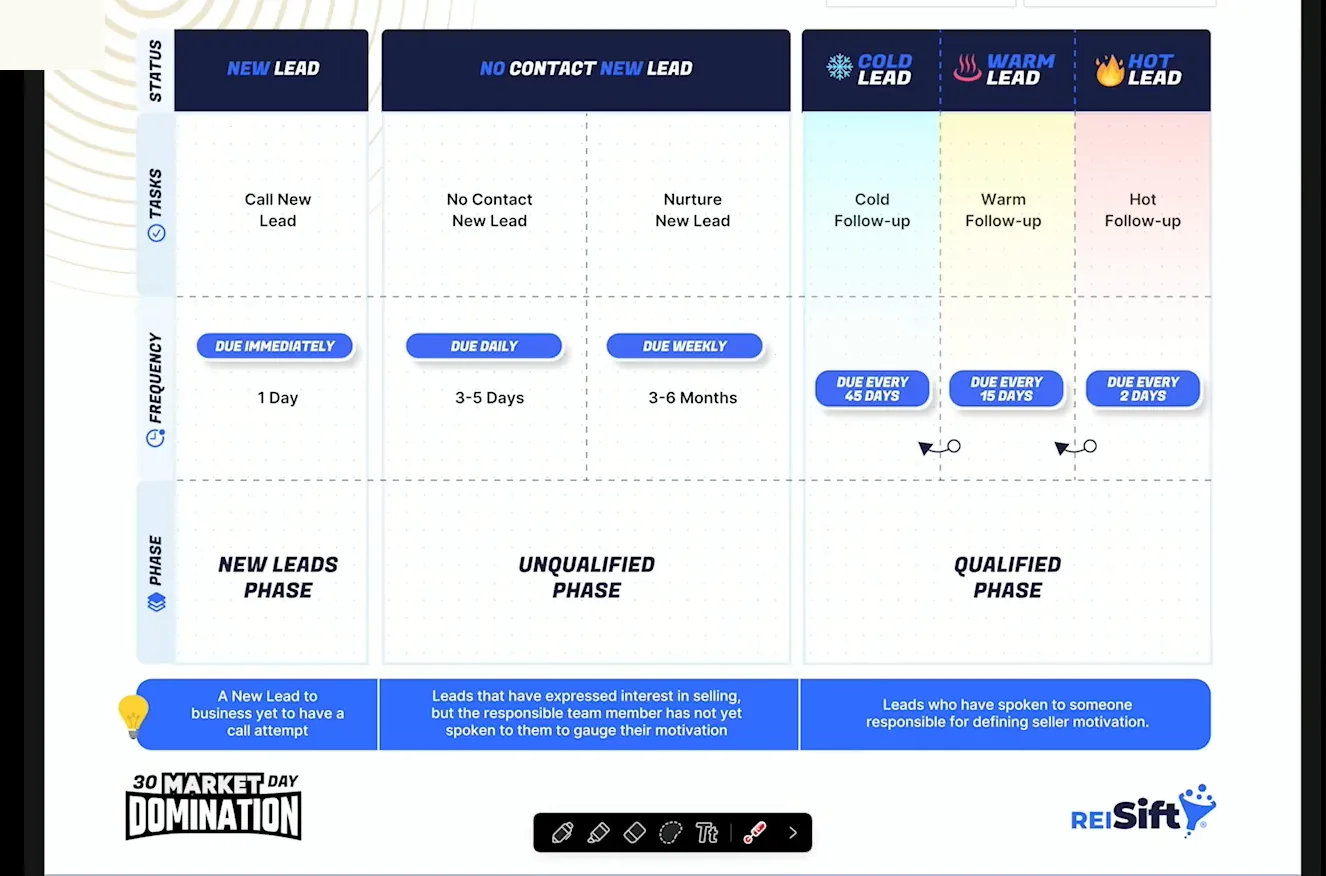
Read the phase as the place in the sales cycle.
The phases themselves are pretty similar to your statuses. But phases are the overall, where in the sales cycle is a record.
So when you look at a phase, you are asking one thing. Where is this record in the cycle right now.
And then the phase themselves, which is really pretty similar to your statuses, but, phases are the overall, where in the sales cycle is a record.
Statuses sit inside the phase.
Match the status to where the record sits in the phase.
Statuses is where it is at in the phase. For example, we have a record status which means it is new to our business. That is also the new lead phase, because there is a hand off that happens here between these phases.
So the task that is going to be on the record is call new lead. It is going to be due immediately. It is due by, I believe, eighteen hundred the day of.
It is only going to be in there for one day. It should be completed that day. If not, maybe the lead comes in later in the evening and you get it done the next day.
So one day is all that it should be inside of this phase.
New lead
A new lead record should only be one day.
- 1Status set to new leadIt means the record is new to our business, and that is also the new lead phase.
- 2Call new lead taskThe task that's going be on the record is call new lead.
- 3Due the day ofIt's due immediately, by eighteen hundred the day of.
- 4Task completed that dayOne day is all that it should be inside of this phase.
The new lead phase.
Put a record in new lead before any call attempt.
This is our new lead phase. A new lead to the business that is yet to have a call attempt. So if you are in this phase, it means the lead is new to the business.
A new lead to the business that is yet to have a call attempt.
New lead phase
A new lead to the business that is yet to have a call attempt. It does not matter if it came in from our website, a PPL lead, or a cold caller from our call system.
Accept new leads from every source you run.
It does not matter where it came from. Maybe it came in from our website, or a PPL lead came in from somewhere, or a cold caller from our call system.
That could be Call Tools or Ready Mode or Smart Dialer or Kixi, any of our integrations. Or maybe you are inside of REI Sift doing some manual click to call calling.
Then you change the status of a record to new lead. That is what we are going to do when I show you this inside of REI Sift.
BEFORE YOU MOVE ON