
PART 1
Saturation and sales cycle on every list.
Every list you pull can be read two ways. How much marketing it has already absorbed, and how fast it turns into a closed deal. Chapters 1 and 2 walk the pyramid from the slowest lists down.
The pyramid breaks all of this down.
Start with the pyramid before you pick a list.
When you're thinking about saturation and sales cycles, this is the perfect pyramid that kinda breaks down all of this stuff. It puts the slow, unsaturated lists at one end and the fast ones at the other.
Read both things on any list you are about to pull. How long it takes, and how many people are already marketing to it.
When you're thinking about saturation and sales cycles, this is the perfect pyramid that kinda breaks down all of this stuff.
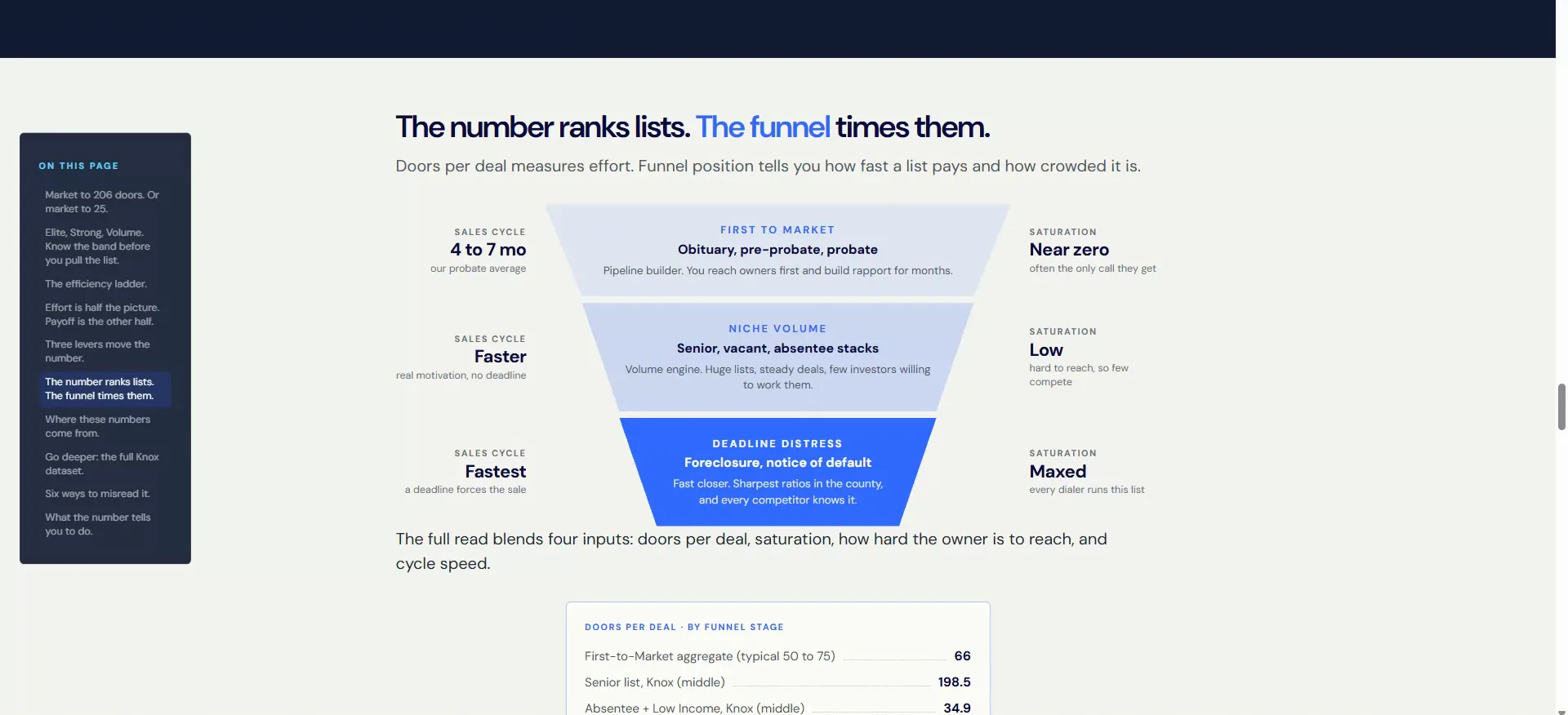
Expect the longest cycle on first to market lists.
We talk about first to market because of the whole concept of being the first ones to reach them. That sits against lists with much faster sales cycles in general.
So I like to break it down by this is the first ones to market that typically have the longest sales cycle. From the day you start marketing to them, it takes the longest to become a lead, then a contract, then a closing.
From the day that you start marketing to them, this is going to take the longest amount of time to actually become a lead, to becoming a contract, to actually closing as a deal.
Death related distressors have nearly zero saturation.
Plan four to seven months on death related lists.
We found that death-related distressors typically have a four to seven month sales cycle. That covers obituary, pre probate, probate things, or anything else tied to a death.
The trade off for that long a wait is there is nearly zero saturation. The amount of people who have actually gotten that list and put it into a marketing flow is very, very small.
And we found that on obituary, pre probate, probate things, or just anything that is a death related distressor, that's typically a four to seven month sales cycle.
Sales cycle
Death related distressors have nearly zero saturation.
Move down to senior homeowners, vacants and absentees.
Go down a little further into senior homeowners, vacant properties and absentees. Those broader lists do have a little bit faster sales cycles. With senior homeowners, they have been sitting on the property for a long time, so they are ready to move.
With a vacant or absentee home, there is a chance they do not live there, or the property is even vacant. Those go much, much faster. That saturation is not zero, but it is lower than some of the other ones.
Use foreclosures and notice of defaults for speed.
Then we get down into the fastest sales cycle. If you get them and they are actually motivated to sell, and the price works, it can close really fast. These are things like foreclosures or notice of defaults.
BEFORE YOU MOVE ON
PART 2
Sales cycles versus saturation.
Now we pair the two axes with the doors per deal framework. You read how fast a list decides, and how much marketing it has already absorbed. Then you pick lists that cover the whole funnel instead of one corner of it.
First to market crushes.
Read each list's decision window before you market it.
If someone is in foreclosure, they have to make a decision fast. Weeks, not seasons. That pushes the sales cycle short whether you are ready or not.
Lis pendens runs longer than that. And if you are in a judicial state like New York, it takes much longer again. So these are not perfect rules of thumb, but they show you the whole thought process.
Or if you're in a judicial state like New York, it's gonna take much, much longer.
Get the correct number and a verified contact.
First to market crushes when you actually reach the person. That means the correct phone number, or a not interested campaign, or a verified contact on file.
This is where the two axes meet the doors per deal framework. You know how many doors you knock, and you know how long that list takes to pay.
Verified contact information and good follow-up.
Count your stack, then count your verified contacts.
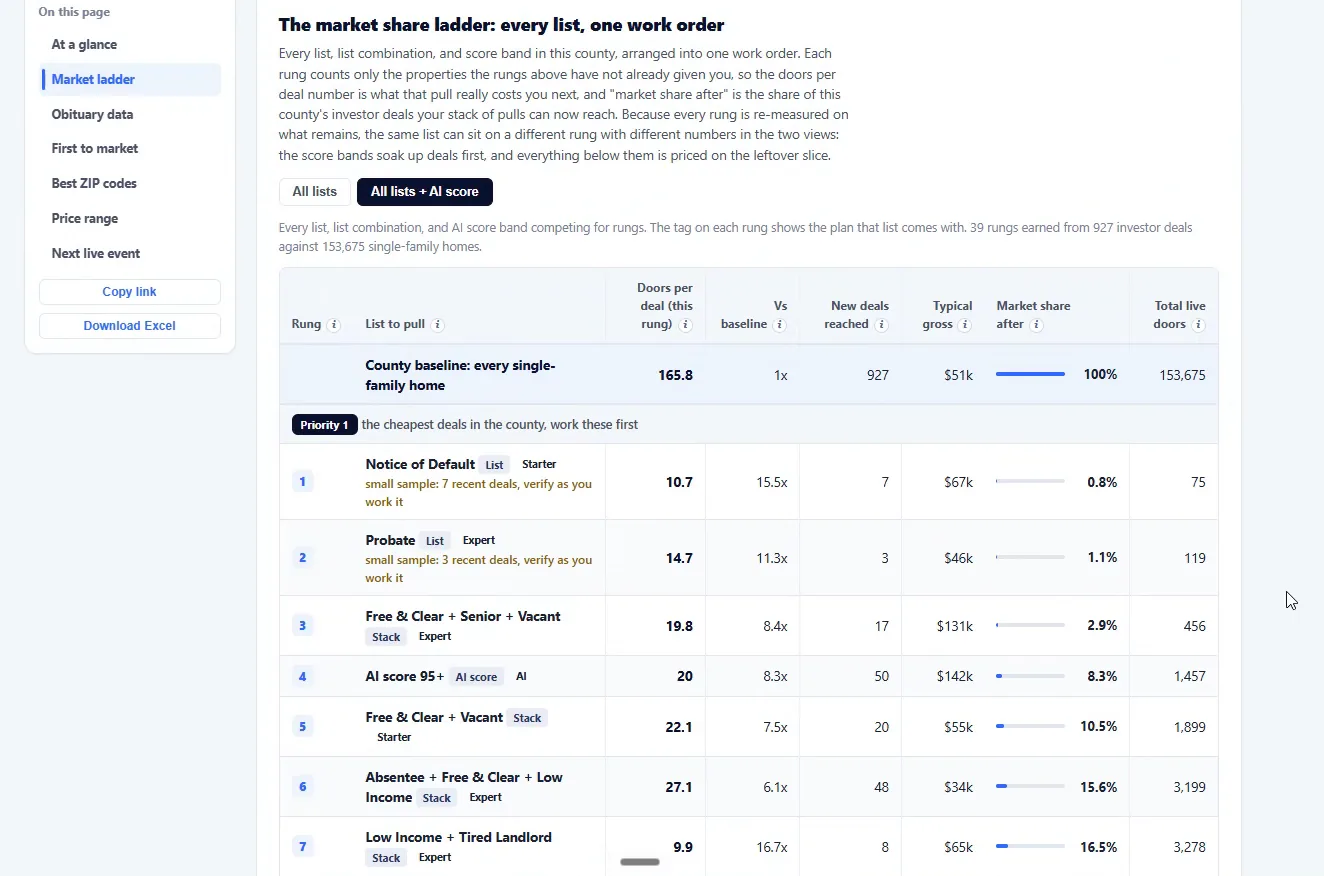
Say we have 456 properties that are free and clear, senior homeowner, vacant, probate and notice of default. That is a nice stack of the entire marketing funnel.
Out of those 456 people, we know 20 of them are going to be selling. Then we run a not interested campaign or a rehash campaign and get 100 people with verified contact info.
And if we get a 100 people of verified contact information, we know at least five of those people are gonna sell in the next six months.
The stack
Out of 456 people, 20 are selling.
Follow up well on the long cycle lists.
Now it is about having really good follow-up and good marketing practices in general. The numbers only turn into contracts if you work them.
In the funnel we want properties on that long sales cycle, first to market strategy, on obituary or probates. And we don't want to wait six plus months before we get our first contract.
That's going to build that pipeline for a long period of time and yield a ton of consistency if you do it for, a year, let's say.
Cover the whole funnel.
Pick lists that cover every part of the funnel.
Mine is a perfect example. We have the senior homeowners and vacant. We have the probate for the longer sales cycle.
Then we have the free and clear senior homeowners with a vacant flag for that mid tier of the funnel. Saturation there is low ish and the sales cycle is a little bit faster.
And then we have our notice of default auction sales that are really, really fast.
My own lists
Four lists cover the entire funnel.
Treat the auction lead as the rare fast one.
Every once in a while we get a really good auction lead. That is going to be a very fast sales cycle.
The catch is the competition. Everyone already has that list by the time you get to it, so you are not first to market on it.
It's gonna be super, super competitive because everyone already has that list at that point.
Run all of them together for consistency.
When you have all of them together, that is what yields the clarity and the consistency over a long period of time. The slow lists build the pipeline. The fast lists get you paid now.
One list on its own gives you one speed. The funnel covered end to end gives you both.
BEFORE YOU MOVE ON