
PART 1
From prospector to lead manager.
This lesson walks the whole run, from someone saying yes, I'm interested in selling, to an appointment that gets set. I'll start with how we handle the lead management side, then the floor numbers we hold everyone to. Part 1 covers the intro and the handoff.
What this lesson covers.
Run one seller conversation from first yes to booked call.
In this lesson we go over everything that has to do with going from a prospector to an actual lead manager. That is the whole process, from getting someone to say yes to setting the appointment.
This is one of those that's pretty interesting, because I think it's changing with the times as things continue to evolve in the REI sector.
I'm interested in selling to setting that appointment to, hopefully, closing them from there forward.
How we handle the intakes.
Have your prospectors take every prospecting call.
There are a thousand different opinions on how you should be handling the sales process. So I'll start by explaining holistically what we are doing.
We are local. That's the first thing. It's a lot easier for us to go in and see all these different properties.
Our prospectors take all of the prospecting calls. They do their calling, they respond to the text messages, and we're also having them take some of the mail.
Let one person manage intakes and outbound together.
Taking the mail is a newer thing for us. We really didn't want to deal with pulling people off the do not mail list when they say hey, never mail me again. It got really annoying for closers to do that.
So they are managing all of the intakes. They get a blend of inbound leads, and they do their outbound prospecting.
Hold the dial floor for prospectors and lead managers.
These metrics are universal across the prospector and the lead manager. They have to do a minimum of 150 dials per day. It's usually higher than that. That's just the floor.
If you have to put in stupid rules to make sure they're hitting these dials, then you've hired wrong. Stupid rules are usually an indicator that you have bad people on your team. There is software that watches someone's screen all day, and I am so against that.
But we have to do a $150 minimum, and then that is going to come down into 20 to 25 conversations.
BEFORE YOU MOVE ON
PART 2
The four pillars and the walk rule.
Every note our prospectors write ties back to four things. Why they want to sell, the timeline, the condition, and the price. Here is the deal that shows you why we stopped waiting for all four.
The four pillars of motivation.
Write every note against the four pillars.
We try to keep this as simple as humanly possible. The reason they want to sell, the timeline they want to sell in, the condition the property is actually in, and then the price.
Everyone on the team is trained on it. That is what makes a note useful to the person who picks the call up next.
Everyone's trained on, like, this is exactly the notes that we wanna see every single time, which is all tied back to the four pillars of motivation.
Four pillars
Every note ties back to four pillars.
- 1ReasonThe reason that they're wanting to sell.
- 2TimelineThe timeline that they want to sell in.
- 3ConditionThe condition that the property is actually in.
- 4PriceThe price they are asking.
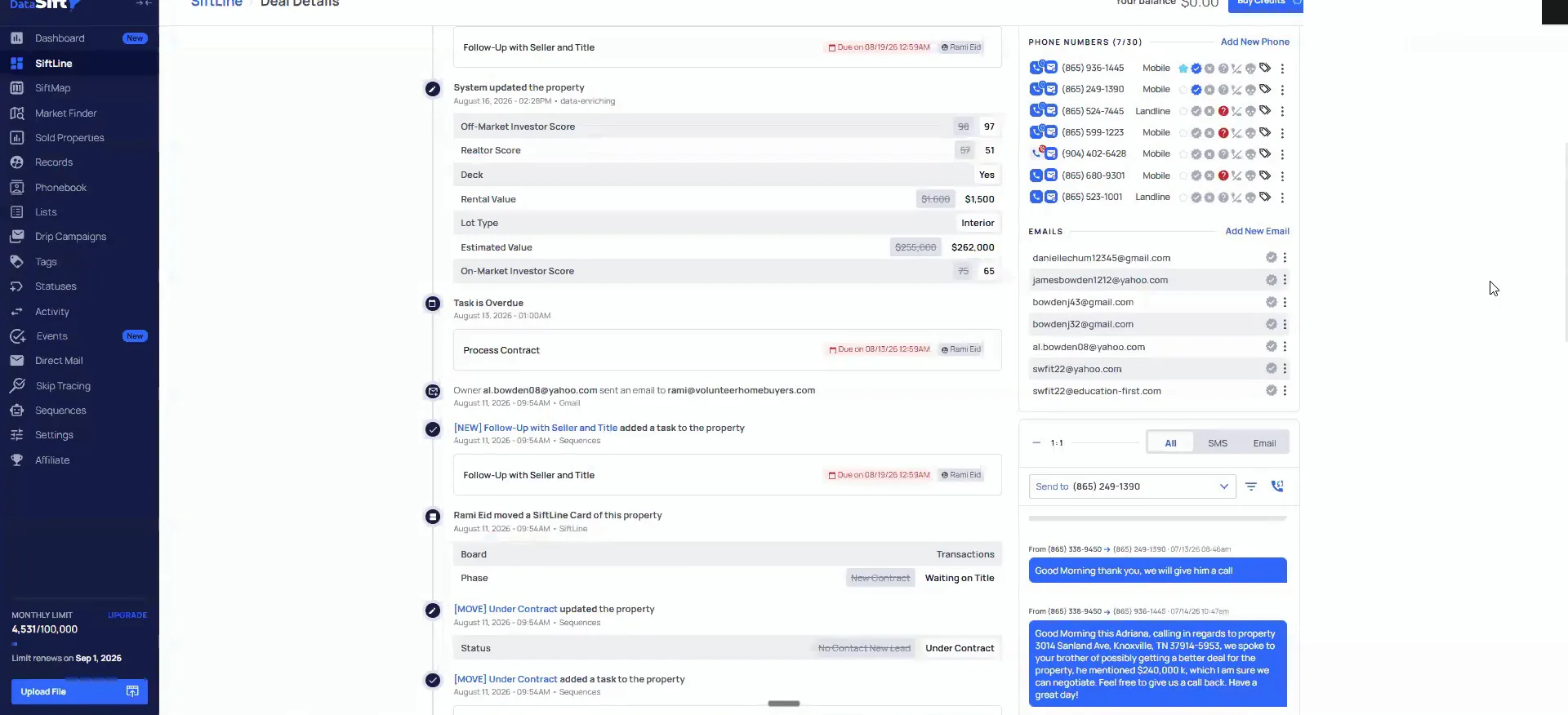
Read the note from the calling process out loud.
This lead came in through the calling process. They texted back, we called them, and took them through this. Alan Boden called back and the note went in.
He said he is interested in selling. I asked twice and got no decision, and he got upset when I probed on the pillars. He wants to sell as soon as possible, the property does need work, and his asking price is 240,000.
He was rushing me because he had to go to work, and he wanted a callback later that day. Even a rude, half finished call gives you three of the four pillars.
I but he does says he wants to sell as soon as possible and said the property does need work, and his asking price is 240,000.
We just want to walk.
Book the walk when one or two pillars show up.
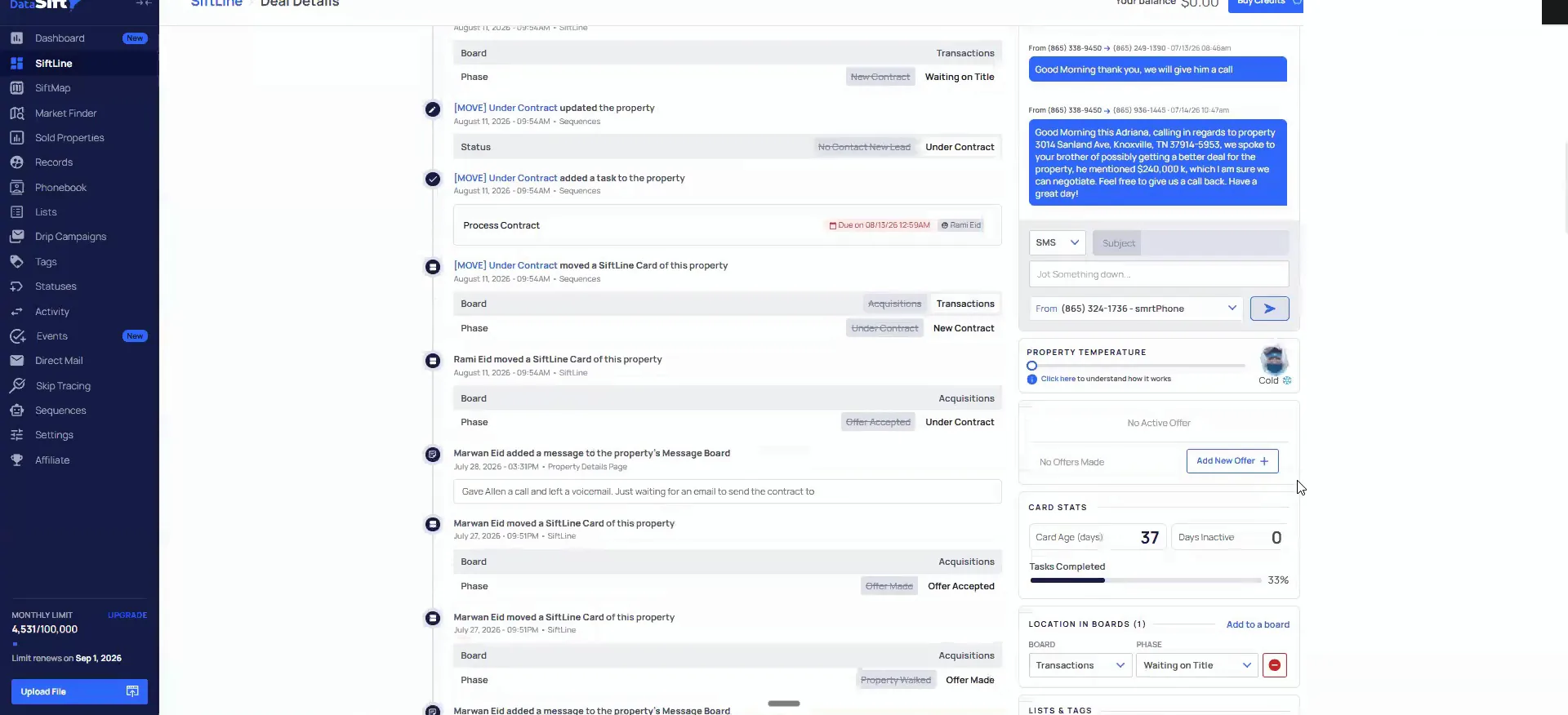
This one had an AI score of 97 and it was vacant, so it sat in my top four on doors per deal. The reason box is checked, because the list is one we know empirically is proven. The timeline is ASAP and the condition is bad.
Anytime sellers say the property needs work, in my experience it is probably a shithole. So we said fine, we are going to walk it regardless.
We are on the side now of we just want to walk. We give offers to everyone if at least one or two of these pillars are present. We do not really care what the asking price is when that much motivation is already there.
In my experience, anytime that sellers say that the property needs work, it's probably a shithole just from my humble experiences.
The walk rule
We just want to walk and give offers to everyone if at least one, and especially if two, of these pillars of motivation are present. When the timeline is ASAP and the condition is bad, we don't really care what the asking price is.
Hand it to the closer and take the drive time.
From this we call and say hey, the closer is going out to walk the property in person. You could do all of this virtually. We chose the drive.
The odds you get a good deal when one or two pillars are present, especially three, are way, way higher. We are willing to eat the sunk cost of the time when the odds look like that.
Compare the asking price to what you locked up.
His asking price was 240. The ARV on this is probably $2.25 to $2.50 on the high end, so on paper it looked dead.
We ended up getting this property under contract anyway. That is the whole reason I picked this deal to show you. Finding the asking price next to what we locked it up for is the annoying part.
One thing that does drive me a little nuts is trying to find everything in terms of the actual asking price versus what we locked it up for.
BEFORE YOU MOVE ON