
PART 1
How long a lead sits.
This part walks the first phase change in a live account. I wake up as the lead manager, open records, and work one new lead until it has a next action. Nothing sits.
From new lead to dead lead.
Move every lead to its next phase, every morning.
So this is gonna go from no contact new lead, to where we actually make contact. Is it cold, warm, or hot? Is someone ghosting you? Is it a dead lead?
Then we get into where it goes next. Back into lead management, or back into prospecting, and everything in between.
And how you actually push it back to the lead management process versus pushing it back to the actual prospecting process and kind of everything in between.
The morning flow on records.
Open your records page and go to new leads.
I'm a lead manager. I wake up in the morning, I gotta do my flow. I go to my records page, then my new leads. Boom. I got one to do.
I click into the record. Let's pretend this is the primary number right here. I put it on me again real quick, so I know it's assigned.
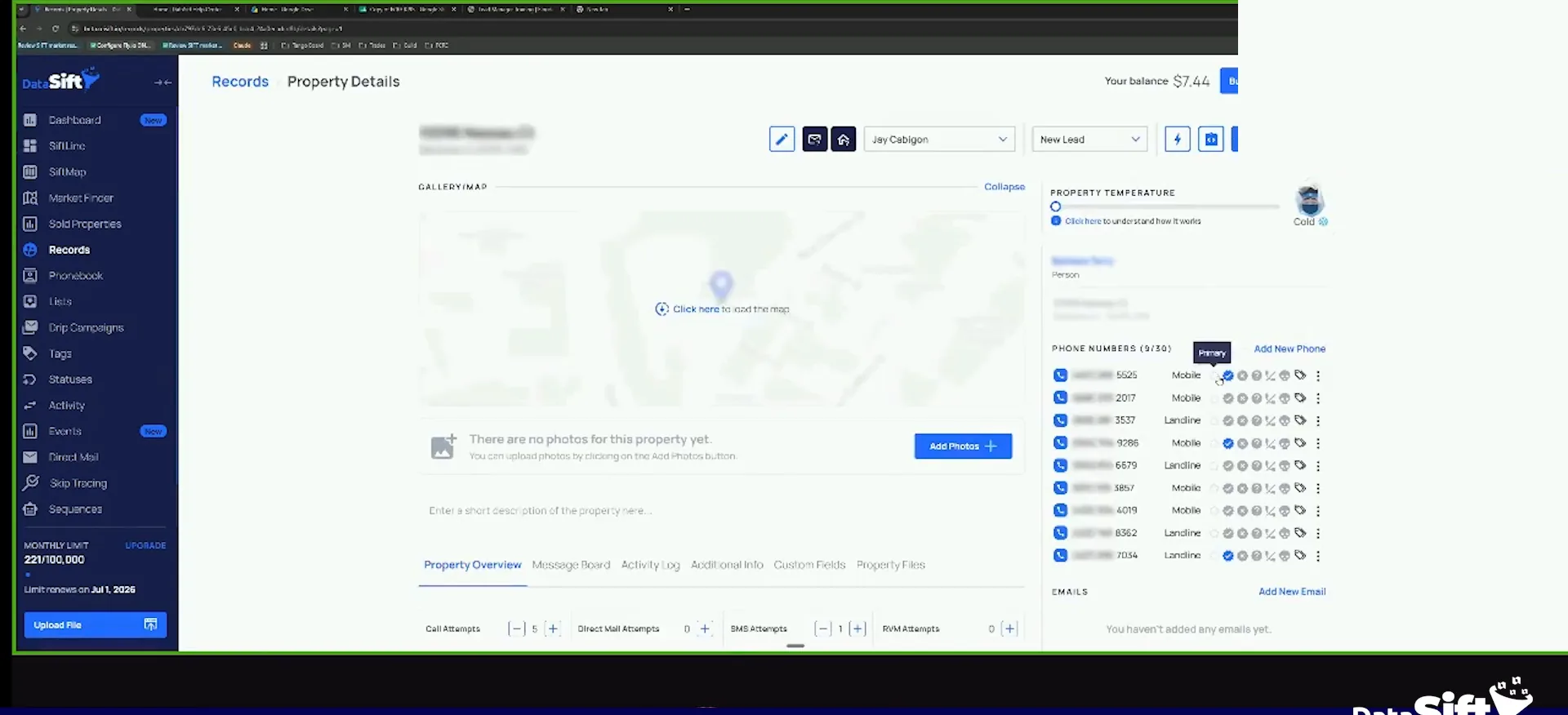
Read the message board, then call the primary number.
So I see new lead. It's assigned to me. Good. I got a primary number. I see it's got the task, got new lead in it.
Let me review the message board from the callers first. Then I call them. Ring, ring, ring, ring. They don't answer. No big deal, I've attempted to call them.
So I'm going to complete my task, and then I'm gonna move it to no contact new lead, which is gonna add a no contact new lead task.
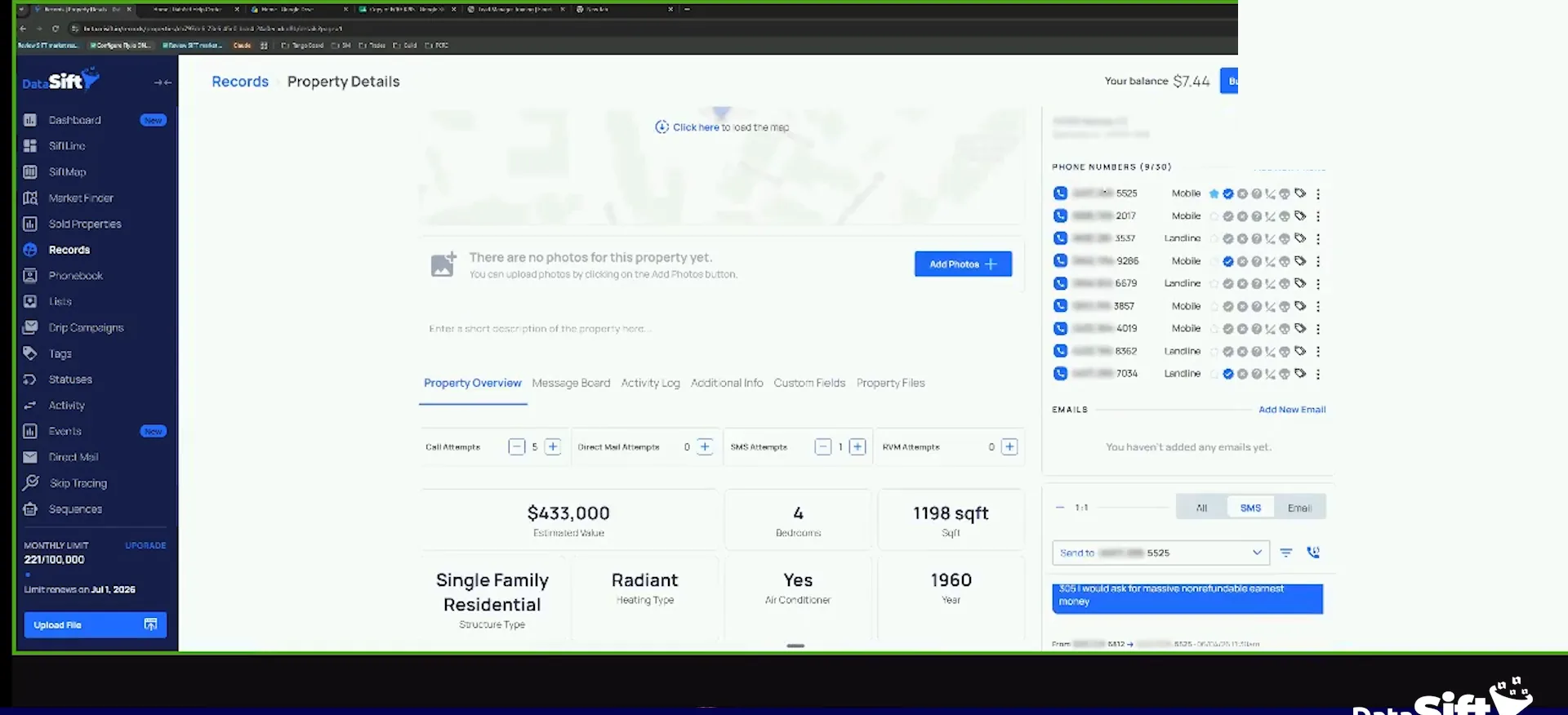
Move the no answer into no contact new lead.
That adds a no contact new lead task. Refresh the screen and the status changes too. I've just moved this from a new lead in my business into the unqualified phase.
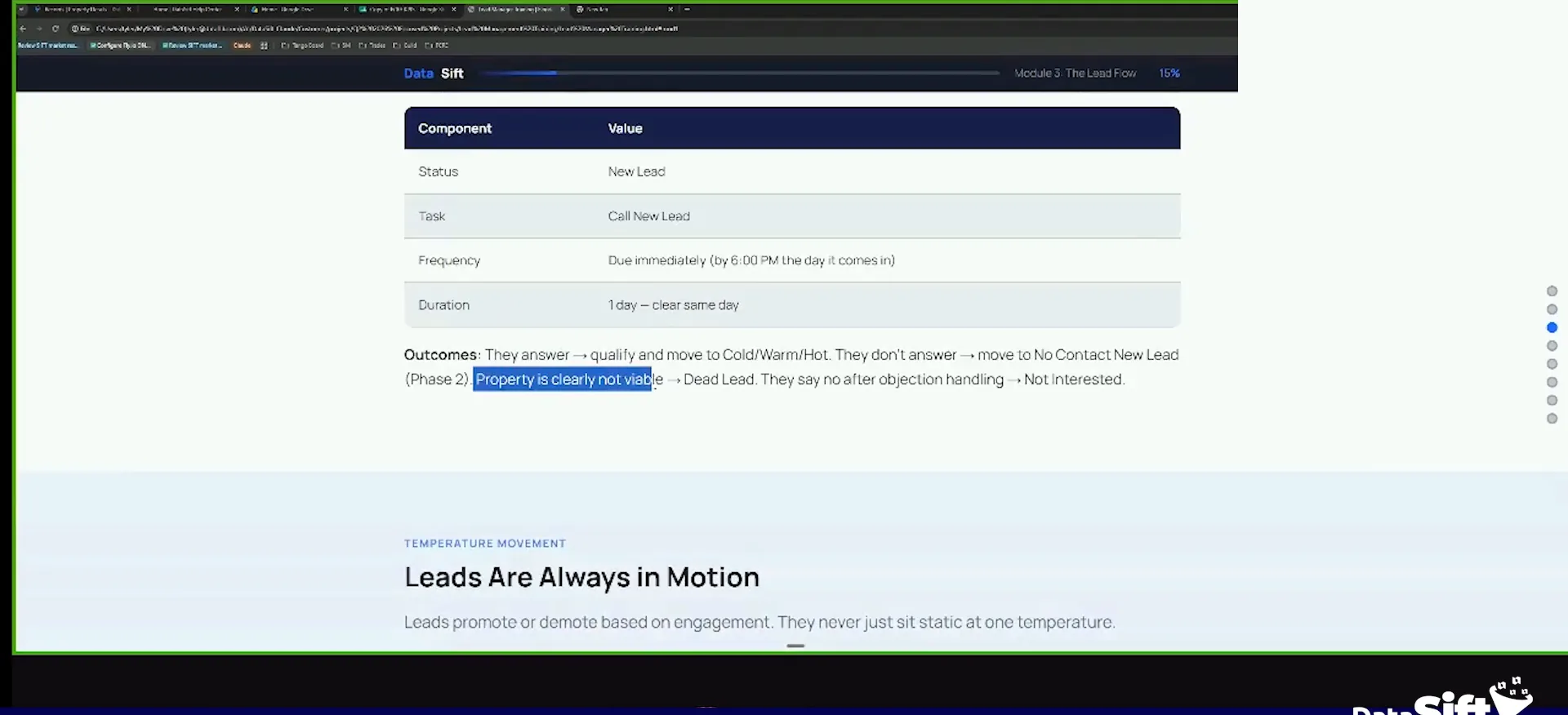
If the property is not clearly viable, you move it to dead lead. If they answer and you've handled all your objections and they're still not interested, you move them to not interested.
Look at this one in SiftMap. It actually sold $400,000. He sold it for $2.90, and we offered $2.50. This was an us mess up. We could have sold that deal, so it's really a lost deal, and I'll update it as sold.
Because they didn't answer the phone, I moved them to no contact new lead phase, which enters them into phase two.
BEFORE YOU MOVE ON
PART 2
Phases, dead leads, and how long they sit.
Now we get to the end of the pipeline and the part nobody likes to set up. A lead that says no still belongs somewhere, and a lead that goes quiet still needs a next action. Here is how I move records down the phases and how long I leave them in each one.
The dead lead phase is important.
Move a deal you would never do to dead lead.
Say I look at a deal that totally wouldn't make any sense. Really crappy area, one I would never do any business with. I'm just gonna move it to dead lead.
When I do that, it removes it from my board, it changes the status to dead lead, it does all that stuff. So dead lead phase is important. If they say not interested, then I'm gonna move it to not interested. You literally just move it down the phase.
If let's just say a deal that totally wouldn't make any sense.
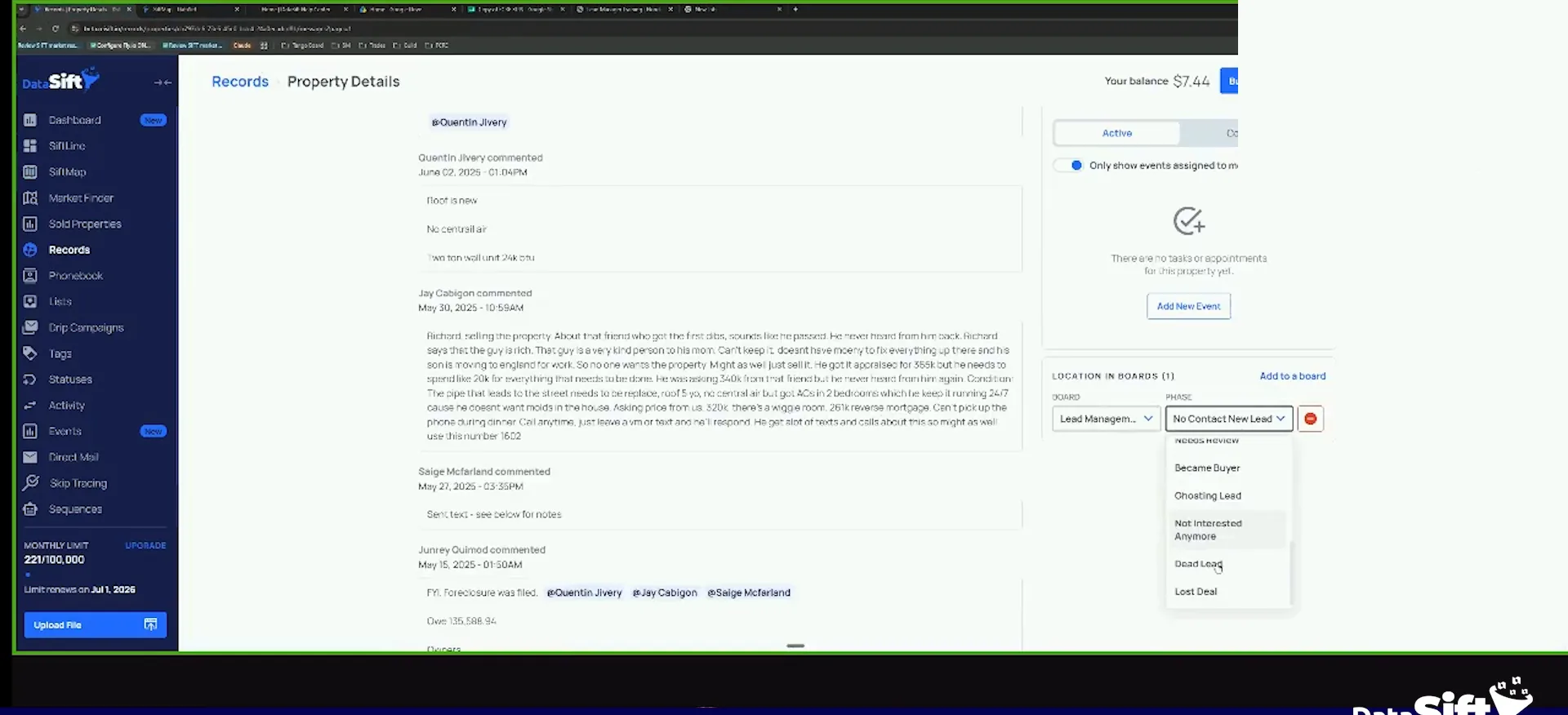
Use phases instead of changing the status at the top.
The reason I do phases is that a phase you can control in a lot of different locations. That is number one. It is also more clear to understand that the record is in a pipeline.
It is easier to train a team. Hey, this is our pipeline, these are the phases of our pipeline, and this is where the record belongs during that phase. It belongs under this board.
And I just use the boards in order to trigger the automations to make sure the right tasks are on it.
Why phases
I use phases instead of changing the status at the top, because a phase you can control in a lot of different locations. And I use the boards to trigger the automations that put the right tasks on the record.
How long do they sit.
Decide how long a lead stays under nurture new lead.
But how long do they sit? Do I leave him under here for a full six months? For three months? For a year? How long do I wanna follow up with someone every single week?
That's where in your business, you gotta put your investor hat on and define what is significant to you.
How long do I let them stay under a nurture new lead?
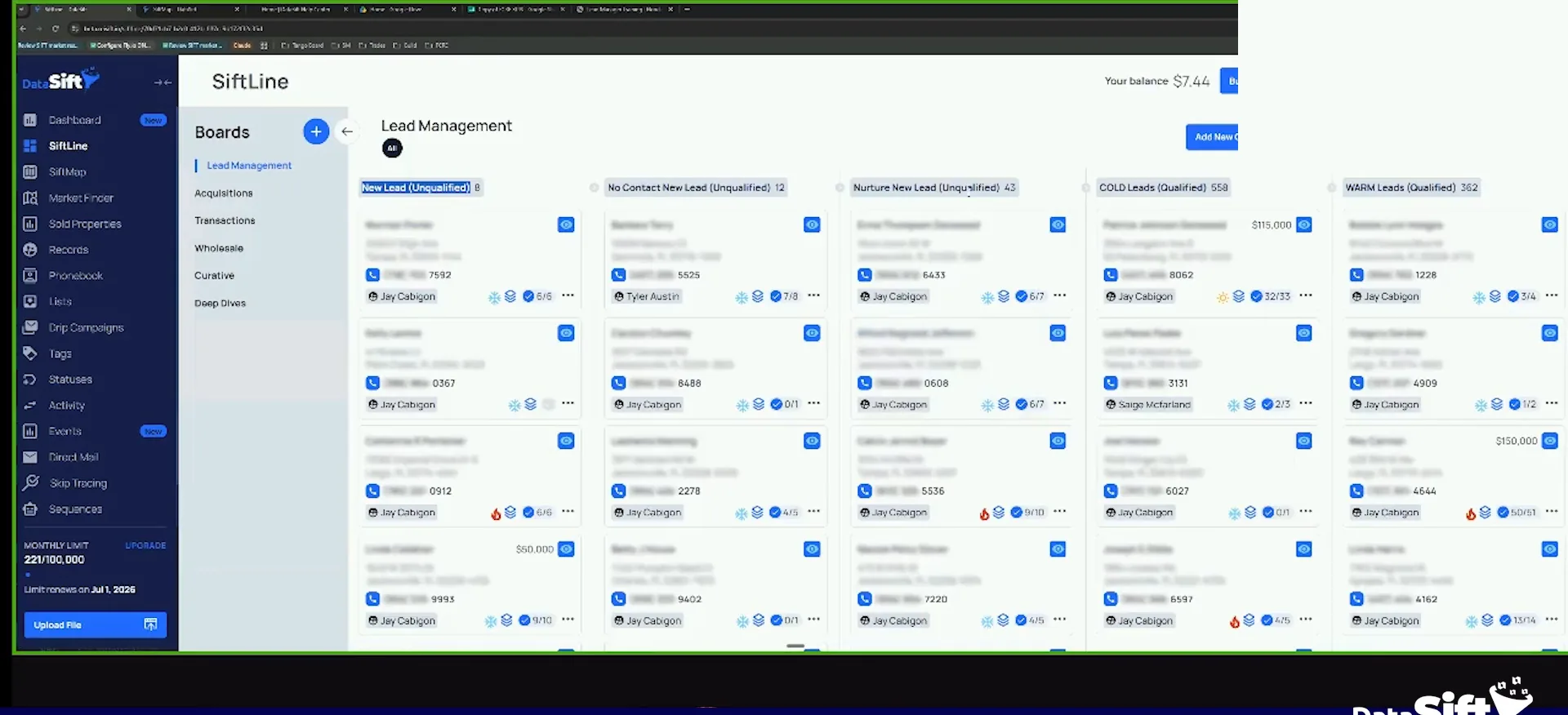
Hold high value property longer and reduce the frequency.
Say they have a ninety plus off market AI score and you have AI data. They are tax delinquent and it is an absentee property. I'm gonna leave it in there a bit longer, then reduce the frequency. The task loops, it automatically completes, and a new one is added.
A high value property stays in there for about six months. Marginal ones between one and three months, and then you move them to ghosting.
Marginal ones between one to three months, and then you move them to ghosting.
Count the touches a ghosting lead already got.
Say they are a new lead. You call them the first day, then you call them five days in a row under no contact new lead, on the daily task. Then you call them every single week for six months.
Add it up and that is thirty one total touches over six months. That is why a lead who never answered still sells later. Somebody stayed on them the whole time.
BEFORE YOU MOVE ON
PART 3
Ghosting, motion, and terminal statuses.
The last part of this lesson is what happens when someone stops talking to you. Ghosting is not the end of the line, it is a quieter follow-up cycle. Then I show you how leads move up and down, and the four statuses that take them out of your day to day pipeline.
Ghosting is a less invasive cycle.
Move anyone who stops communicating to ghosting.
Imagine if anybody important to you called that many times and you never picked up. Imagine the bank calling you that long. You would probably get your card locked out. At that point it is not worth your time either.
So if someone is not communicating with you, move them to ghosting. That takes them off the manual call list and puts them in a lighter cycle.
Imagine if your mom called you 31 times over six months and you didn't pick up the phone.
Call ghosting leads through a bulk dialer monthly.
Remember, every day we are calling these people manually. Every week we are calling these people manually. Ghosting leads are different, because we can use drip campaigns on them. We are just trying to reengage them.
Create a filter on your records page to call through all your ghosting leads. Throw them in a bulk dialer and call through every one of them. I am only calling that person every month rather than every single week.
Follow-up cycle
Ghosting gets a lighter follow-up cycle.
Nurture new lead
- CallingEvery week
- Who callsManually
- Drip campaignsNo
- Why they are hereStill communicating
Ghosting
- CallingEvery month
- Who callsBulk dialer
- Drip campaignsYes
- Why they are hereNot communicating
Open recently sold deals and look for ghosting.
How do I know this works? Go into lead management, recently sold deals, and look. We lost a deal from ghosting right here. It was only one deal, but ghosting leads do sell.
Then I check if it sold to an investor. Thankfully not, so I do not feel near as bad. It is a very expensive home, that is why. Dead leads sell more, and most of the time dead is an acquisitions problem, not a seller problem.
The right amount of attention.
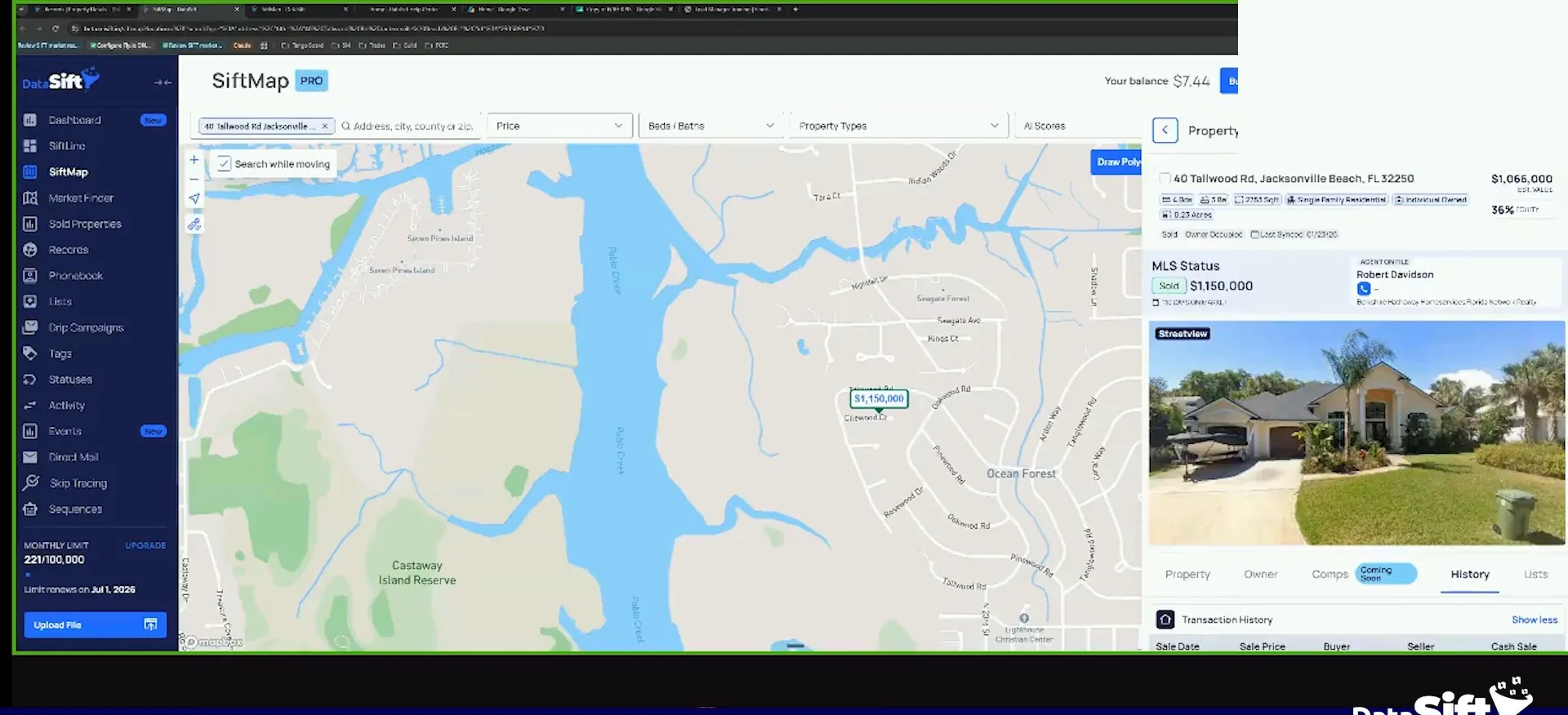
Open the lead in SiftMap before you decide.
You have to be able to understand by looking at the deal, the property and the situation. You have all of the data at your fingertips. So grab one of your nurturing leads and open it up in SiftMap.
On this one I click the list and it is a probate. It was owner occupied, and the on market score is up there. It is in Jacksonville somewhere, and it looks like a decent little area.
You gotta be able to understand by looking at the deal, by looking at the property, looking at the situation.
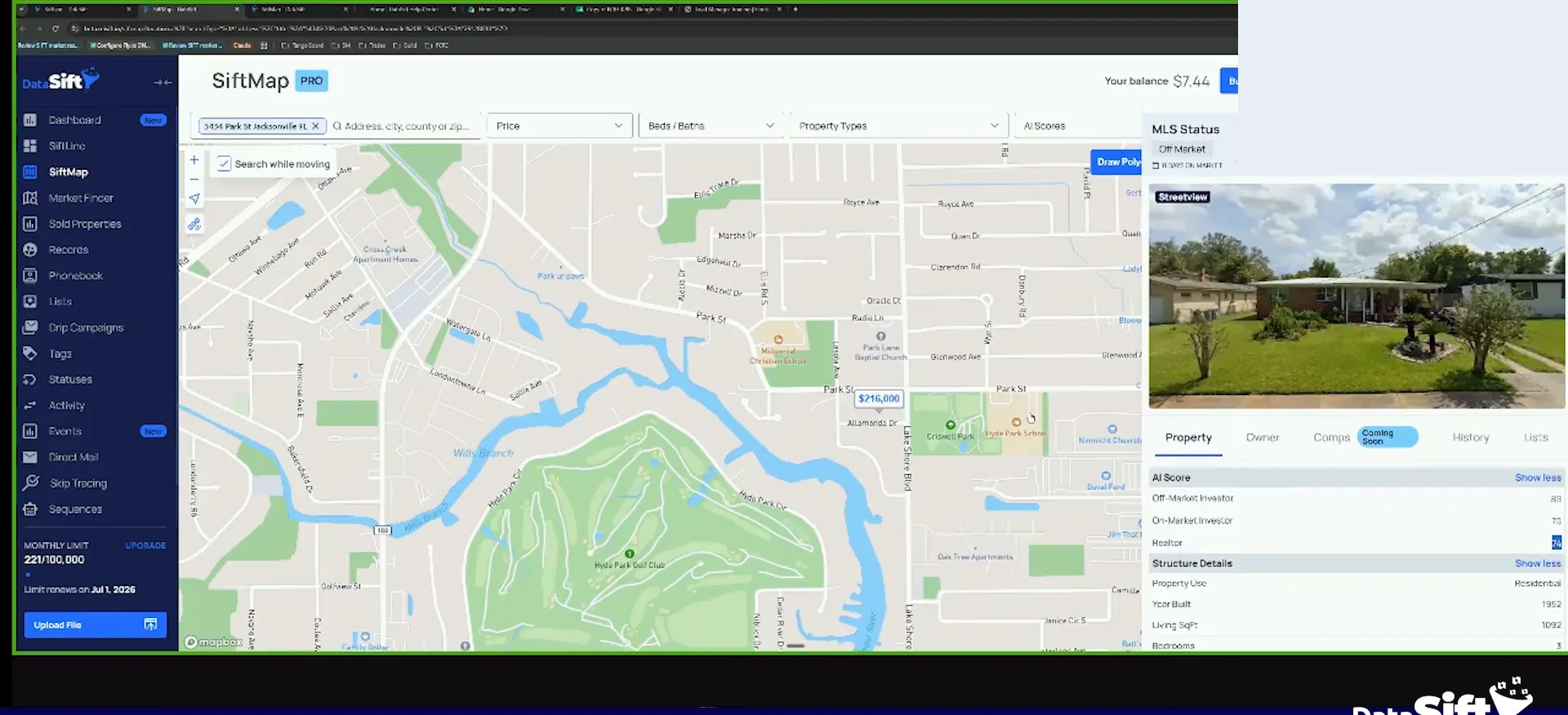
Follow up longer when the score is high.
Is this property going to sell at some point? Yes. So I give it more time than I would give a weaker record.
That is the whole point of looking first. The deal in front of you tells you how much attention it deserves.
It's got an 89 AI score, I'm going to continue to follow-up with them for a longer period of time.
Expect leads to promote and demote on engagement.
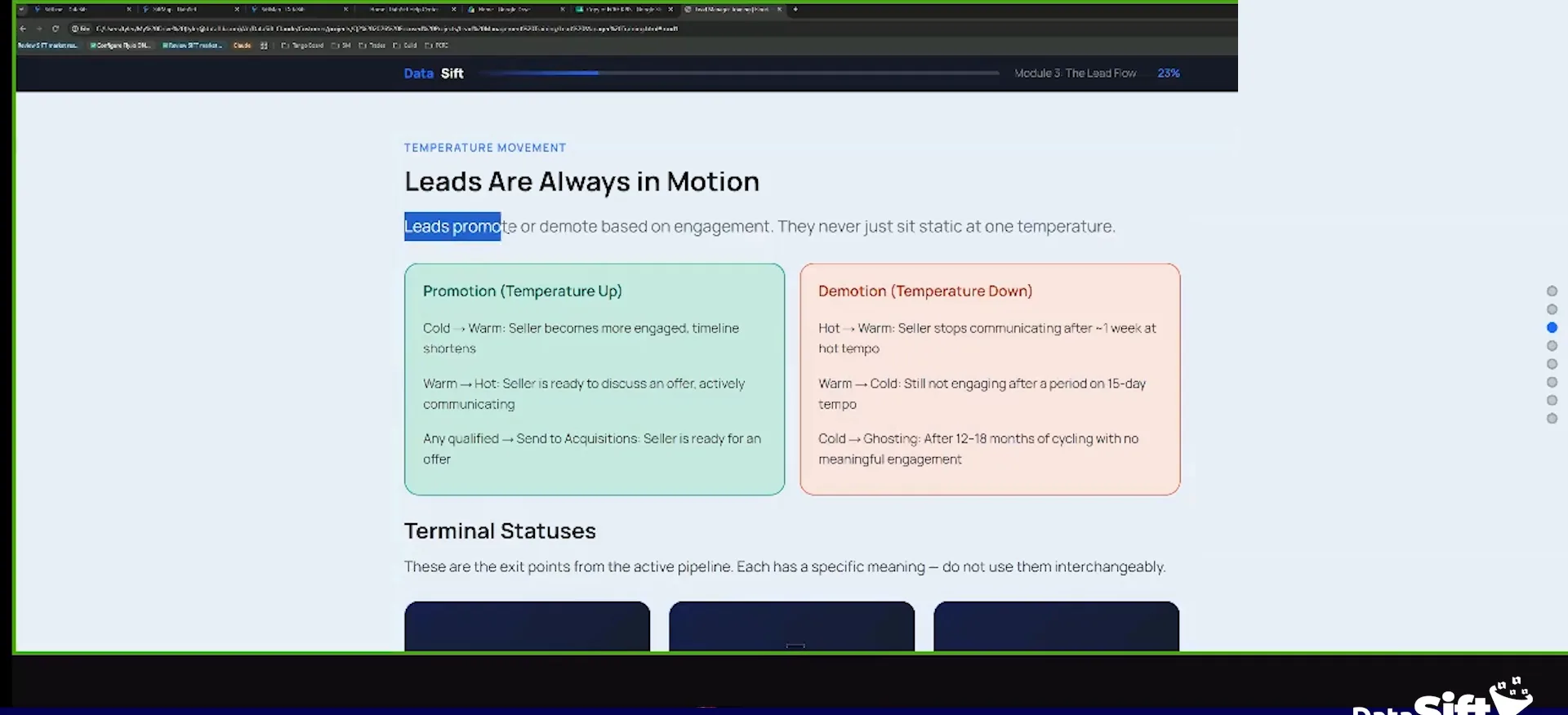
Leads are always in motion. They promote or demote based on engagement, and they are never just sitting static at one temperature. A cold lead becomes a warm lead. A warm lead becomes a hot lead.
Qualified leads go to acquisitions. They reject the acquisitions offer, they get sent back to lead management, and they have to get requalified. If the lead manager did not do their job fully, that hot lead gets demoted and comes back cold.
Four statuses end the pipeline.
Use the four terminal statuses to clear your pipeline.
Dead lead, not interested, lost deal, ghosting. I call them terminal statuses. They are the end of the road in the lead manager pipeline.
Say somebody is a cold lead, you get them on the phone, and they say they are not interested. It gets moved to not interested. All of these move the record out of your active day to day pipeline.
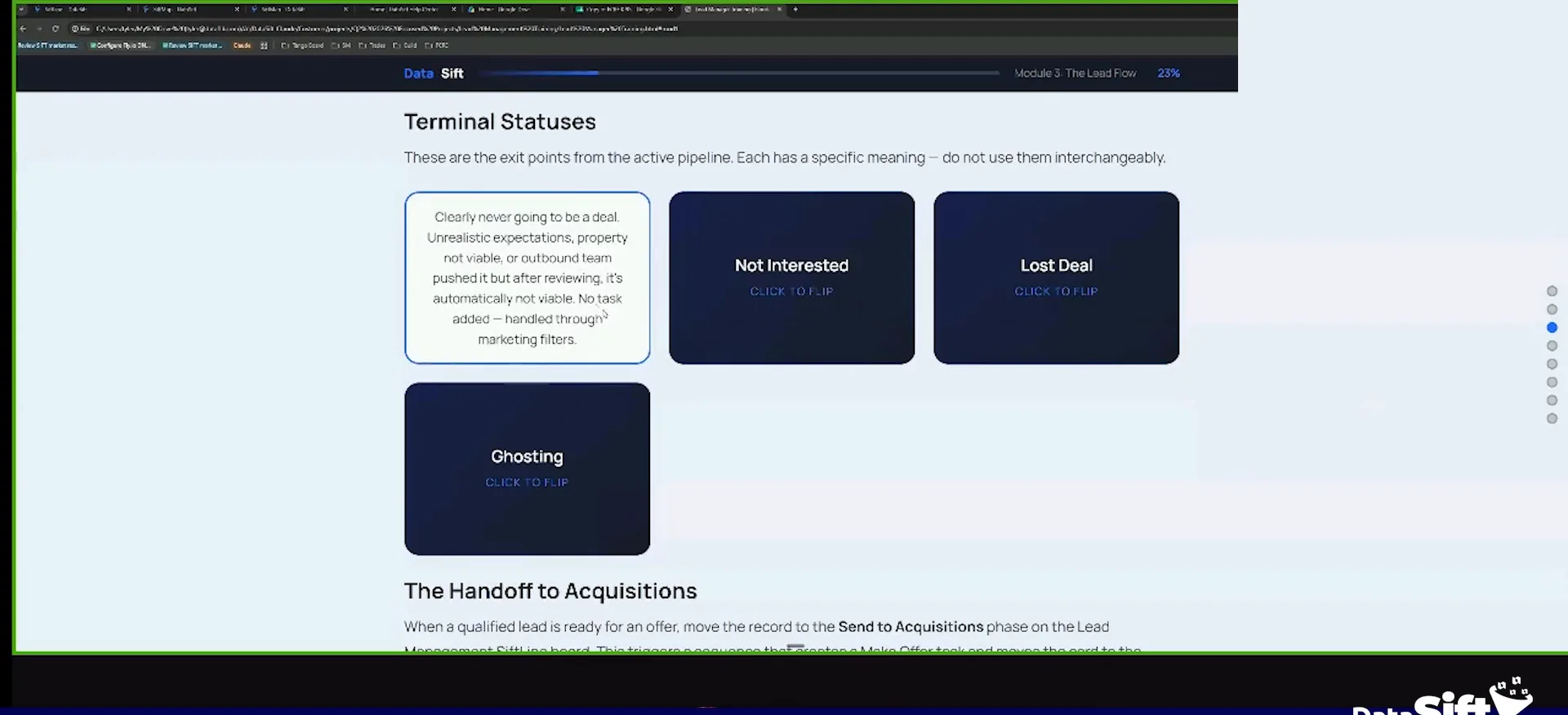
Never move a lead to dead unless it's truly dead.
Dead means you never want to follow up with that person again. So do not use it loosely. Usually it is a training problem or a marketing problem, not a dead seller.
There's usually some sort of sales training that can be done to turn a lot less dead leads into dead leads.
Terminal statuses
Four statuses move a lead out of the pipeline.
Run a follow-up campaign on your not interesteds.
Be careful with not interested. A not interested on a probate does not mean they are not going to sell the house. Look at the situation and decide. I still want those people called again, I just do not want my lead manager spending the time.
So I run a not interested follow-up campaign. Every not interested is really nothing but a cold lead. Lost deals are exactly what they sound like, you open the record and it turns out the property recently sold.
BEFORE YOU MOVE ON