
PART 1
How the pendulum works.
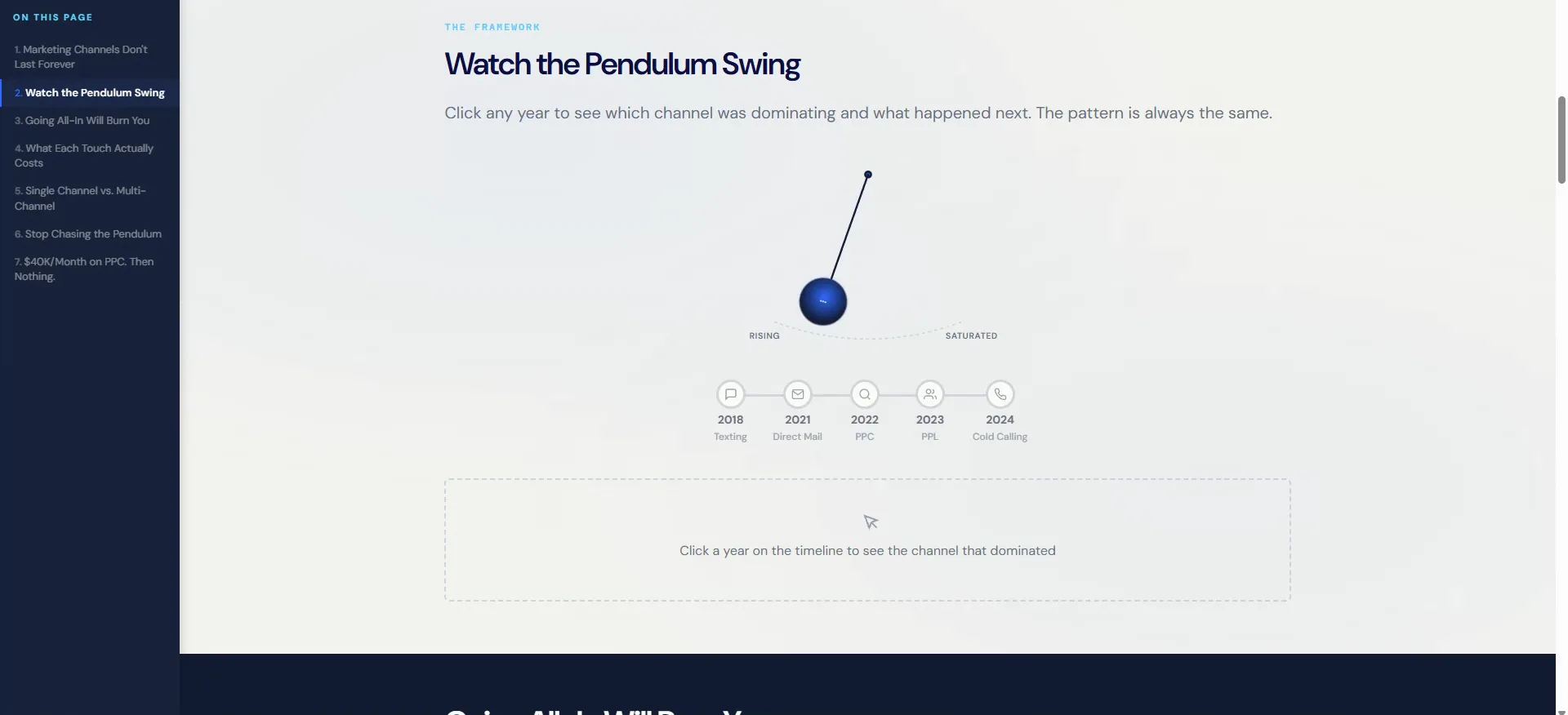
The pendulum is how a seller prefers to be marketed to, and it moves. Every channel below worked, and every one of them stopped working for the same reason.
What the pendulum theory is.
Read the swing as seller preference, not a channel ranking.
The pendulum theory has everything to do with how a seller prefers to be marketed to. It shows which channels are actually performing in the REI space at any given moment.
That is a different question from which channel is best. There is no best. There is only which one is not saturated right now.
Why a channel dies.
Stop treating a channel that works as permanent.
You hear a guru teaching something, or you hear us teaching something, or a friend tells you the strategy is working. It works well for a little bit. Then everyone jumps on it.
As soon as everyone flocks over to it, the entire channel starts to tank for everyone else. That is the whole mechanic.
This is where the inconsistency in this sector comes from. It is not that operators pick badly. It is that they pick correctly and then arrive with everybody else.
As soon as everyone does that, the entire channel just starts to die for everyone else.
BEFORE YOU MOVE ON
PART 2
Three swings, 2018 to 2022.
Each of these was the obvious answer at the time. Each one emptied out the channel everybody had just left, which is what made the next swing possible.
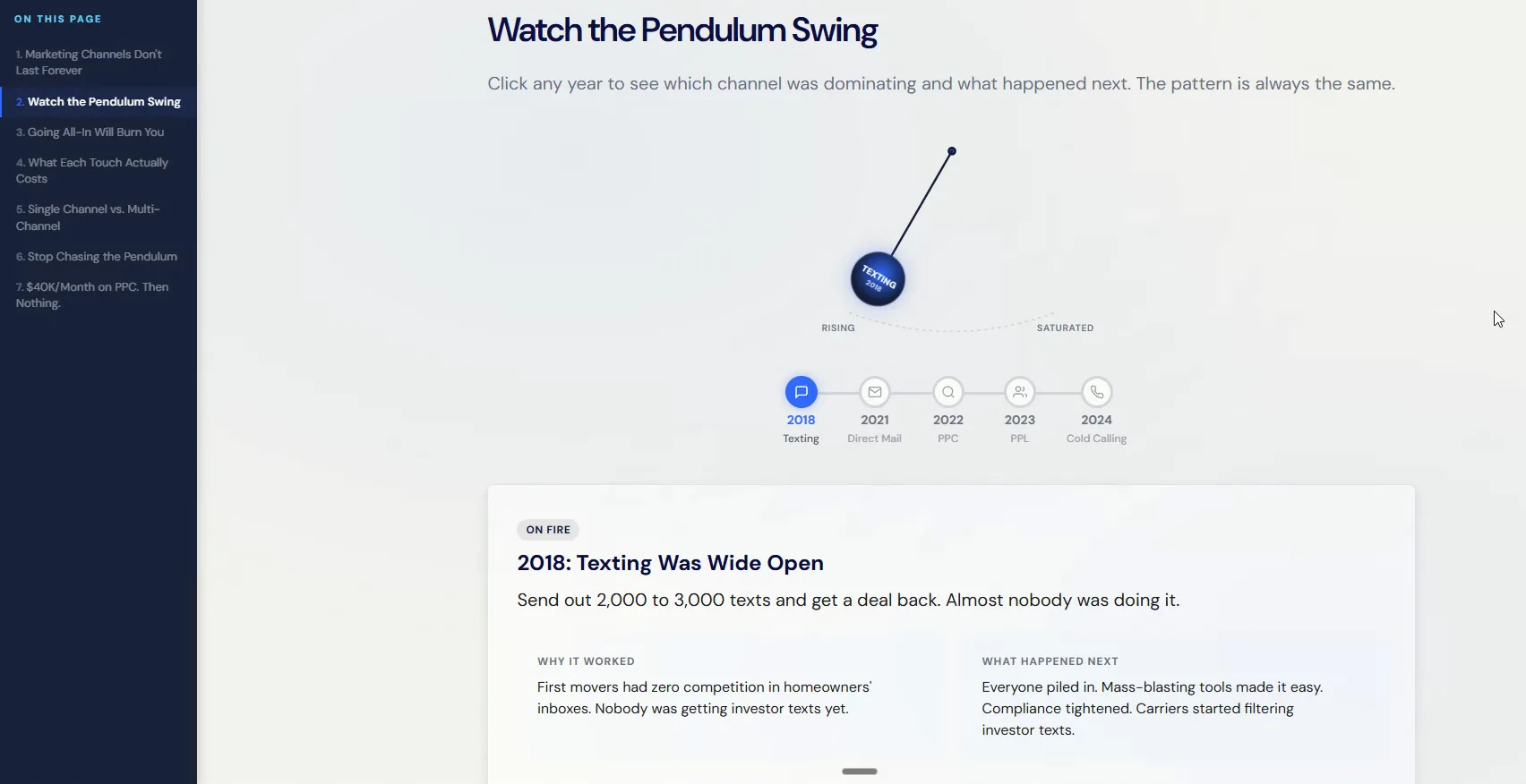
2018: texting was on fire.
Notice what a channel looks like before anyone else arrives.
Back in 2018, when we first got started, texting was on absolute fire. You could send out a couple thousand texts and get a deal back.
This is when outbound really started to be prominent. Everyone was mass texting and mass calling, and bulk was the absolute way to go.
You could send out a couple thousand texts and just get a deal back.
2021: everyone moved to direct mail.
Watch what empties out when everyone moves.
The argument against mail was the math. Why would we ever do direct mail when we could send out a couple thousand texts for about $200 and get a deal that way.
So everyone moved over to outbound, and direct mail became totally unsaturated. Then the people who had left mail for texting all jumped back into mail. This is when the soft offer check starts becoming prominent.
That round trip is the theory in one channel. The move that emptied mail is what made mail worth doing again.
2022: bidding on keywords.
Understand that an auction gets worse as more people find it.
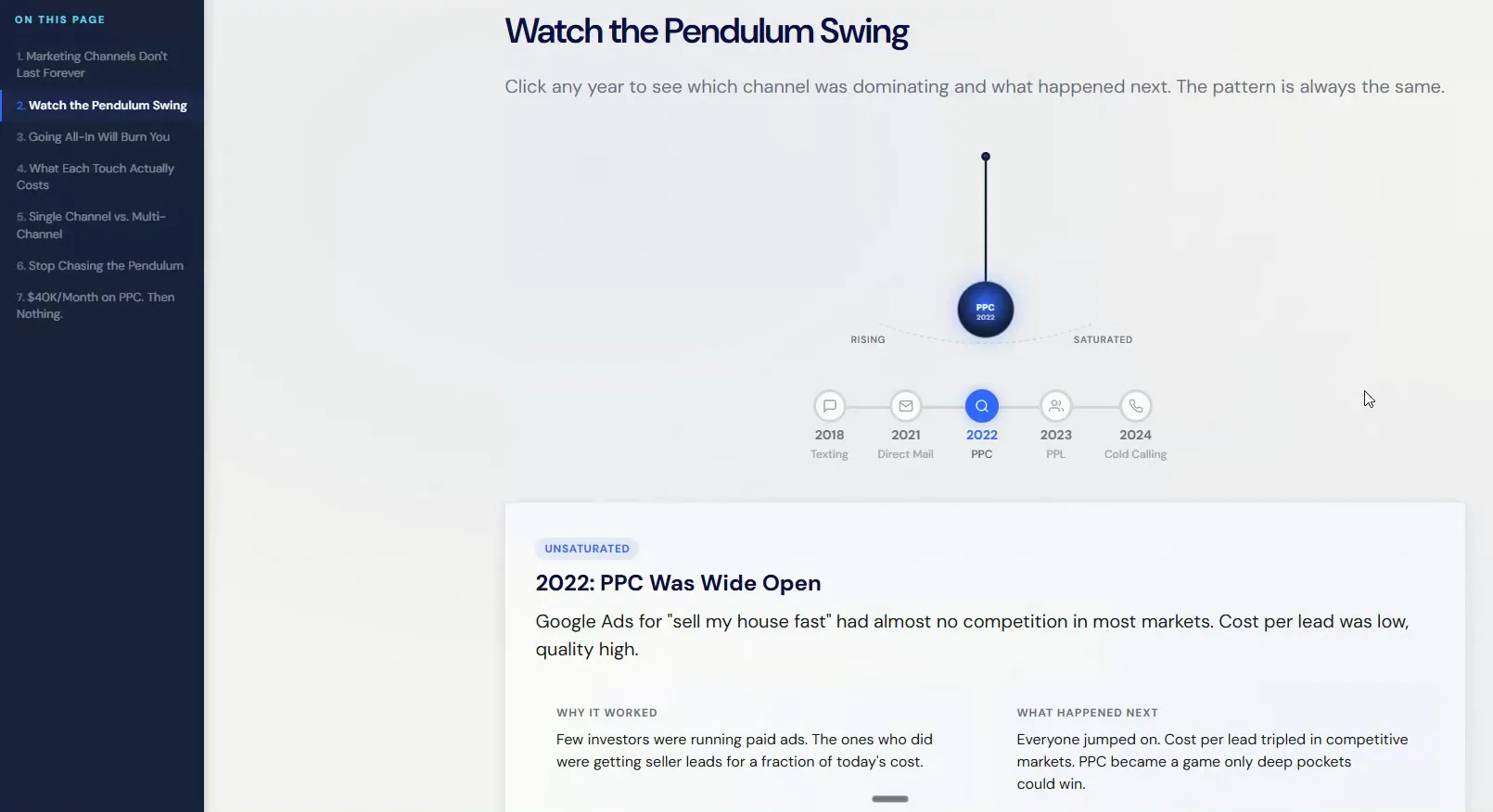
With PPC you are bidding on keywords. Imagine everyone in one market bidding on sell my home fast in Knoxville, Tennessee. Every person joining that auction drives the cost up, perpetually.
It works really well while it is unsaturated. The lead is inbound and the intent is high, because they searched for the exact problem and then got shown the ad that fixes it.
Then 10 or 20 investors flock into that same market. Cost per acquisition goes from $2,000 all the way to $10,000 plus. That is where a lot of people are floating right now when they jump back into PPC.
Every person that is joining that bidding process dries up the cost of that just perpetually.
BEFORE YOU MOVE ON
PART 3
Pay per lead, then back to bulk.
Buying the lead instead of running the ads was supposed to be the way out of the auction. It was the same auction with an extra company in the middle.
2023: everyone moves into PPL.
Price a lead by how many people are getting the same one.
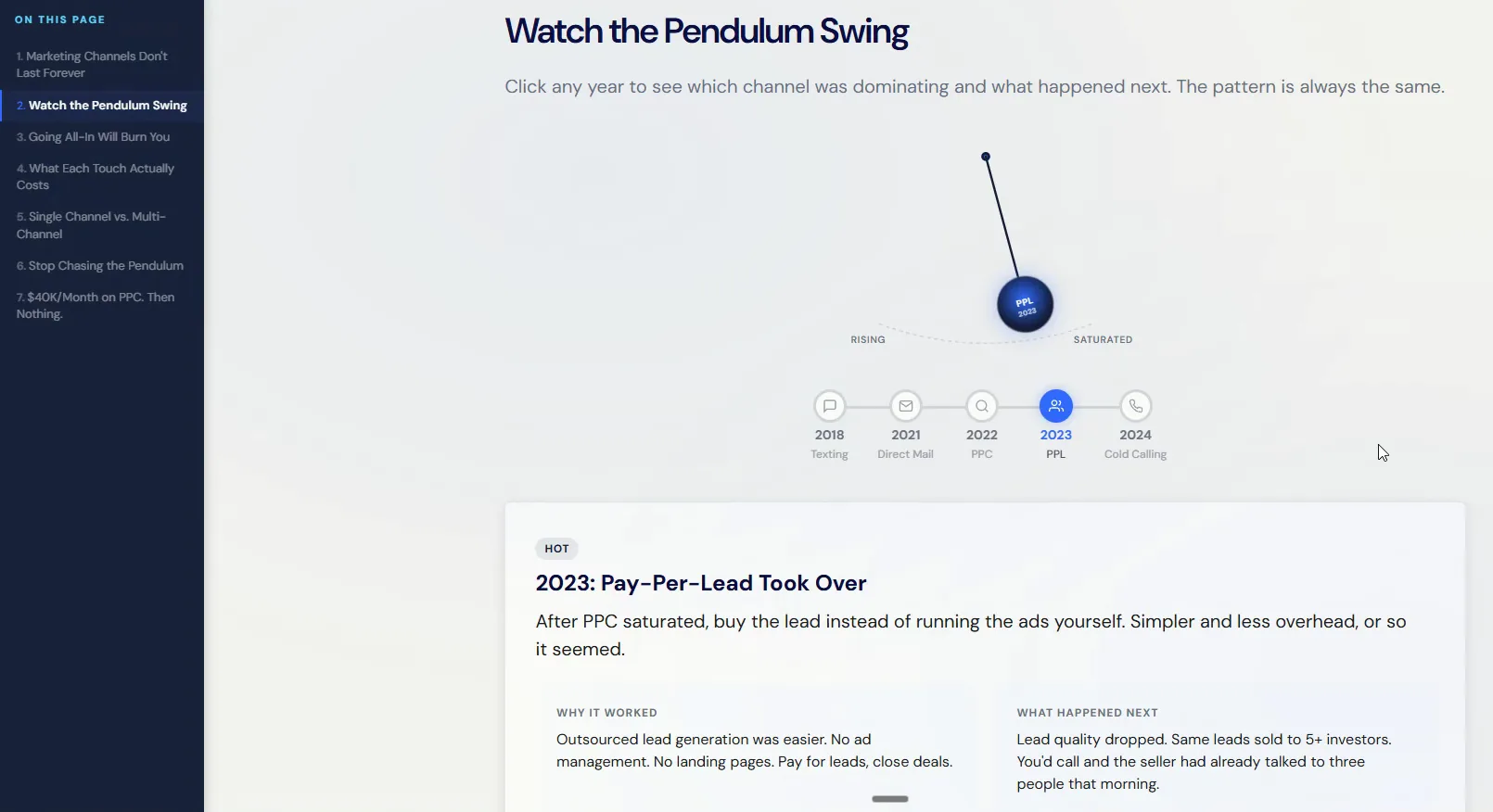
PPL companies generate leads through Meta or PPC, some through calling and texting, then sell those leads to an investor. It runs on a minimum bid and a maximum bid, the same way PPC does.
So you have maybe 20 investors all doing PPL in one market. Some bidding $500 for a lead, some at $150. There are a lot of these companies.
They were making so much money because they would take one lead and sell that same lead to 5 to 10 investors. For a minute I knew people getting $1,000 cost per deal on PPL.
Then saturation came in and clobbered them. All those leads got bid up, and by the time everyone had flocked over, it started to taper off.
They would take a lead. They would sell it to that same lead to maybe five to 10 investors.
2024: PPL dies, bulk comes back.
Expect a dead channel to come back once everyone leaves it.
In 2024 everything on PPL just died. We all reset and moved back to the bulk side: a lot more calling, and texting starting to make a comeback in 2025.
Texting works again because the 10DLC rules from 2022 and 2023 have worn off. It is far less saturated than it used to be.
That is the whole business. People find a channel they like and they all go all in. A guru starts to teach it, you see it on YouTube, and they all flock to it.
They all flock to it and it kills that channel.
BEFORE YOU MOVE ON
PART 4
What it costs, and what still works.
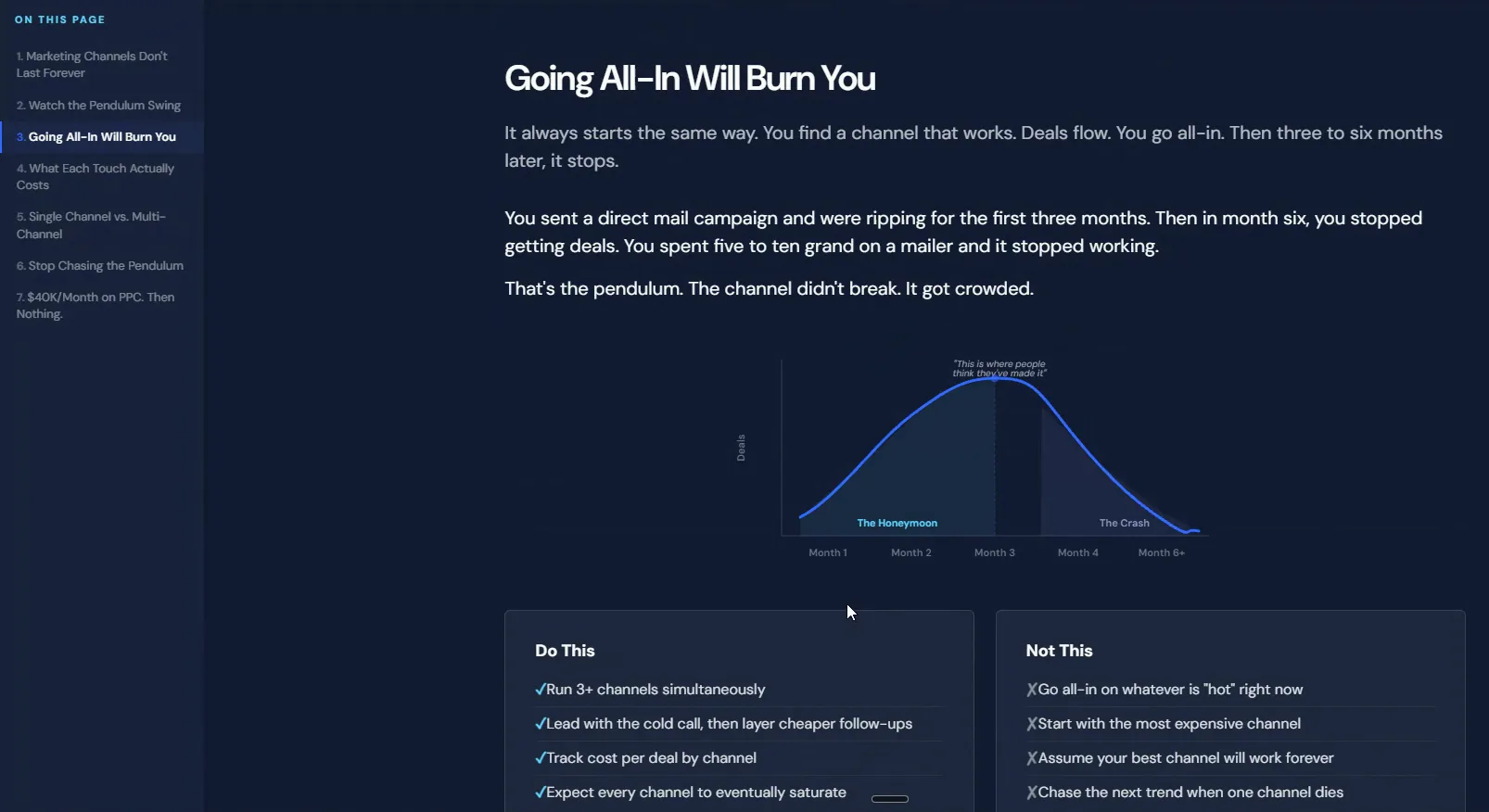
The pattern has a shape and a price. Both are on the chart, and both are the reason the system we teach is built on data rather than on a channel.
The honeymoon phase, then the crash.
Count the months, not the results.
Months one through three are the honeymoon. Everything is working, you hop in, and you think you have made it.
Then month three happens and it tanks. It falls completely off.
That is where the crash catches you, because by then you are all in at $5,000 to $10,000 a month on marketing. You lose that money to the saturation, not to anything you did wrong.
Month one through three, this is that honeymoon phase, everything's working really well.
Build for the swing.
Pick the data first, then the evergreen channels.
The whole ethos of the DataSift curriculum is a system that works no matter what this pendulum is doing. It does not care which channel is performing right now.
That means finding the best data to work from. Then the channels that are evergreen, the ones still there five years from now.
We're trying to give you a system that's going to work no matter what this pendulum is doing.
BEFORE YOU MOVE ON