
PART 1
First to market volumes and order.
First to market is a small list every month, and that is fine. This Part covers how many records to expect. It also covers how to read the ladder on the expert plan.
Why we created these workflows.
Save your admin time on pulling courthouse data every day.
First market was SiftStack. This was the original reason we created all these different AI workflows. Pulling in all this data from the courthouse became extraordinarily tedious. It was very expensive to have a ton of VAs pulling different workflows.
It was expensive having all these different VAs pulling all these different types of lists and cleaning all this data. It is very labor intensive, and also not very fun for our admin teams to be doing. It is such monotonous and boring work.
This is one of the best things in the entire curriculum for saving admin time. It breaks down how to save all that time, and gives you a clean process for pulling in this data every single day.
How many records to expect.
Pull first to market and do not worry about volume.
First to market is always going to be pretty small. Up to 200 records a month is a good amount. That is such a negligible amount compared to the rest of the rungs, so I would not worry about it. Just bring it in.
Eventually you will find out what the max amount is for your county. You will know fast whenever you pull it in.
There are some outskirts. Tyler has a shitload of probates, triple the amount that I do, because Florida is a primarily older demographic than Knoxville is. Naturally there are more deaths, so naturally the probate records are higher.
But for most cases, unless you're in a weird thing like that, it's gonna be one to two hundred per list.
Volume to expect
First to market is always pretty small.
Switch off the AI data if you are on expert.
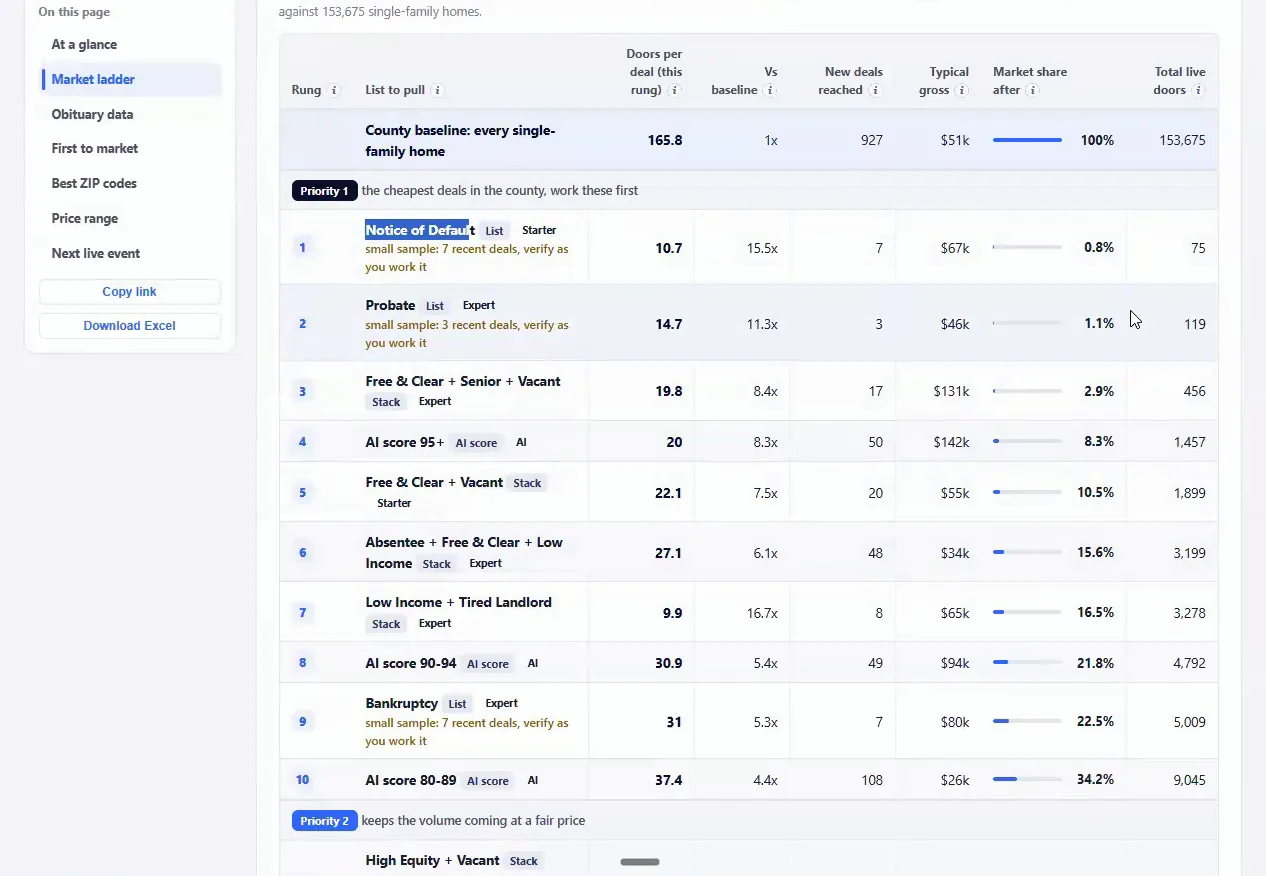
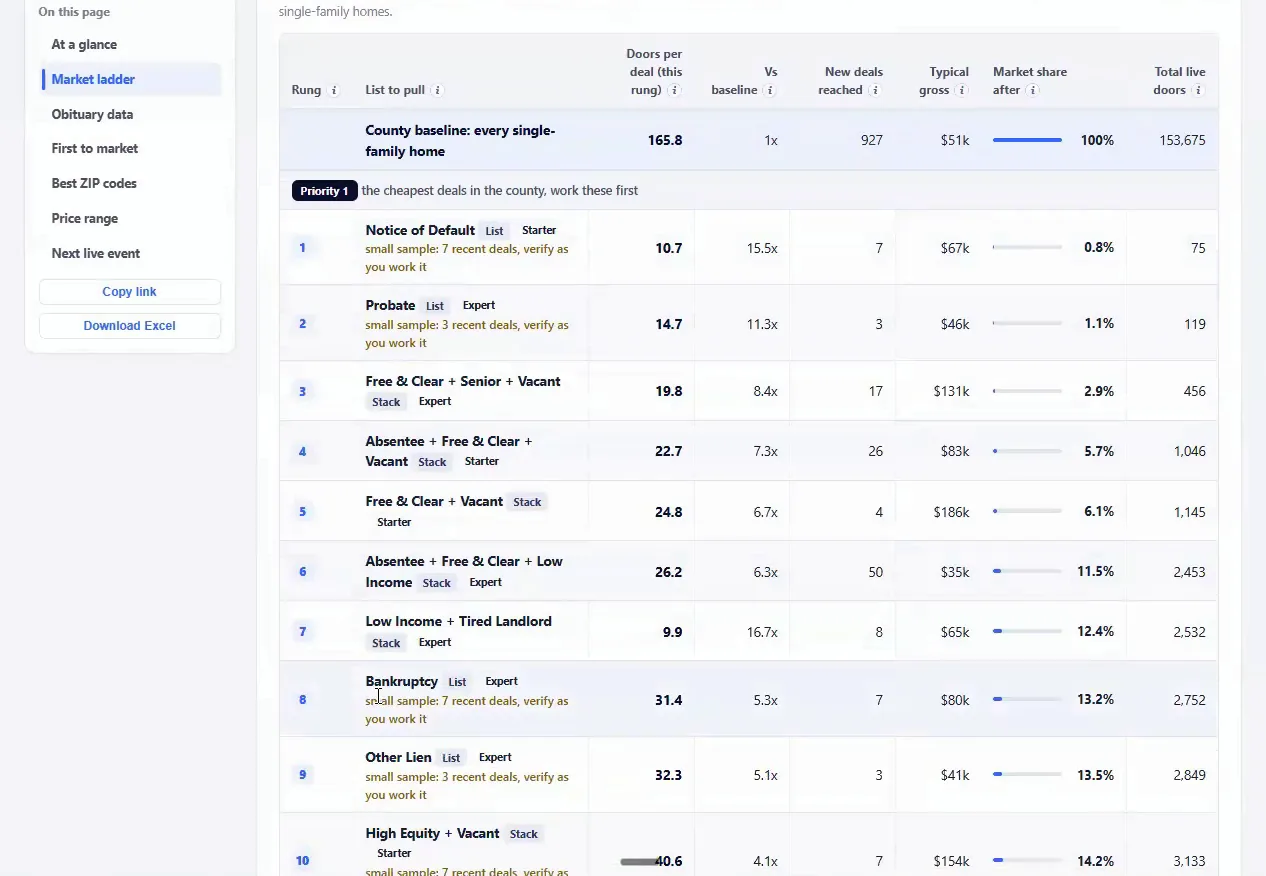
A question came in from someone on the expert plan, not the AI plan. On my ladder the fourth rung is the AI score of 95, and that one comes from the AI plan data. If you do not have it, take it out.
When you do this, it is just breaking down everything except for the AI data. You will notice the order is slightly different, because it is only focusing on the expert plan. That is where most people are going to be focusing.
So click all this, follow it, and do the first three or four. Then throw in first to market with that, combine the two, and work that. It is that easy.
The AI plan, I only do that because that's, what I'm actually using so I can speak on the results a lot better.
BEFORE YOU MOVE ON
PART 2
Deep prospect every obituary property.
Two questions came up here. One about old county data and obituary flags, and one about getting tax delinquency when the county will not hand it over. Here is how I answer both.
The county data is from 2022.
Run the full deep prospecting flow on every obituary property.
Say a property has a deceased owner attached to it. Mom and dad both passed away, and five children potentially have an ownership interest. That is the whole reason to prospect the people, not just the record.
A lot of guys like to pair tax two plus years delinquent with a deceased record. I have found it is better to hit every single property in the obituary flag. I get 60 a month, 75, somewhere in that range, and reaching all of them costs me very little.
The other way, you whittle that 75 down to maybe 10 people who are actually tax delinquent. You saved a few dollars and lost most of your list.
And let's say, for an example, it's mom and dad, they both passed away and there's five, children that potentially have an ownership interest in this property.
Obituary volume
Hitting all of them is pretty negligible in cost.
I run the full deep prospecting flow on every property in that obituary flag.
Copy the SiftStack flow in and bolt the workflows on.
If you really want the tax side in there, take the SiftStack flow from what I built at the beginning of this call. Copy it in and bolt the AI workflows on top of it.
Your county data being from 2022 or 2023 does not stop this. The workflows go out and check the current picture for you.
Check every property manually.
Use the workflow that checks every property manually.
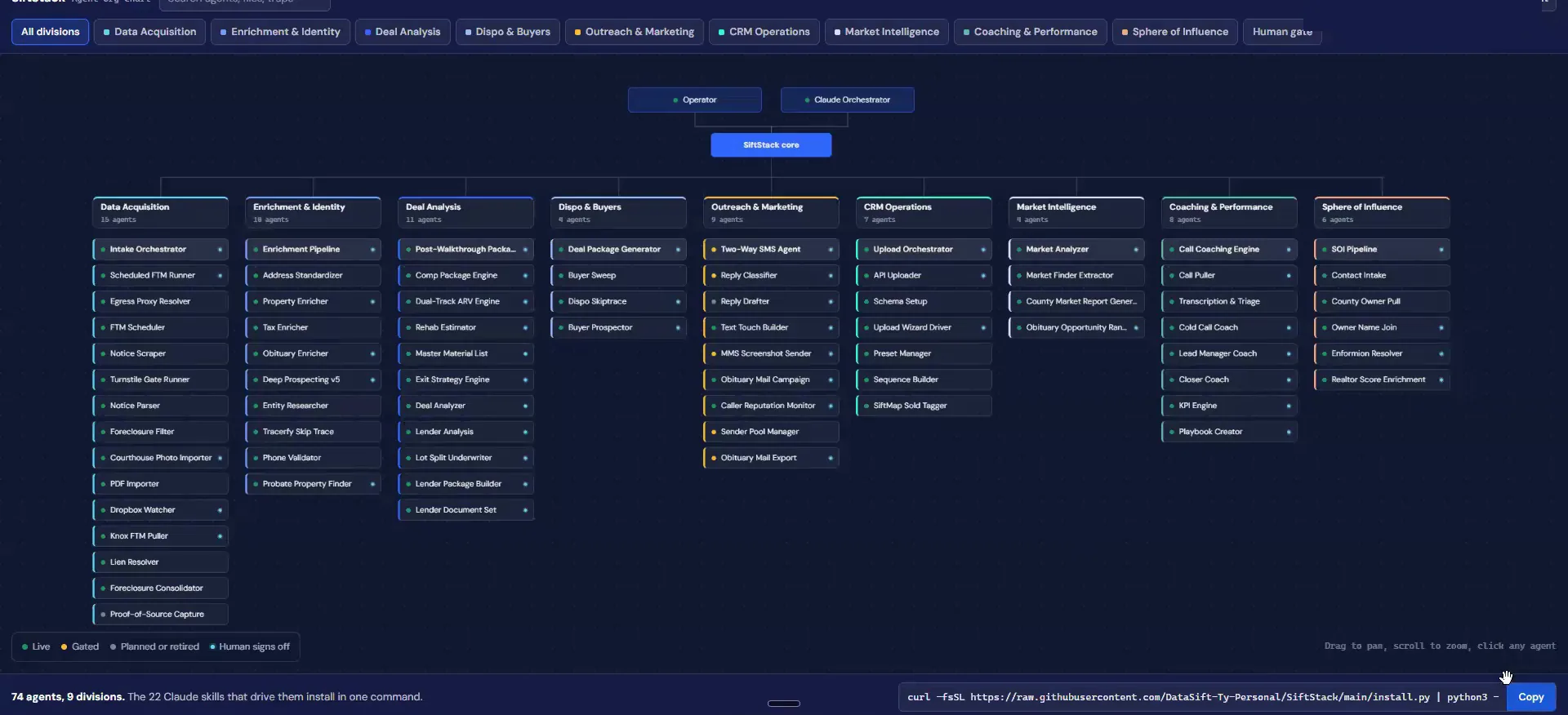
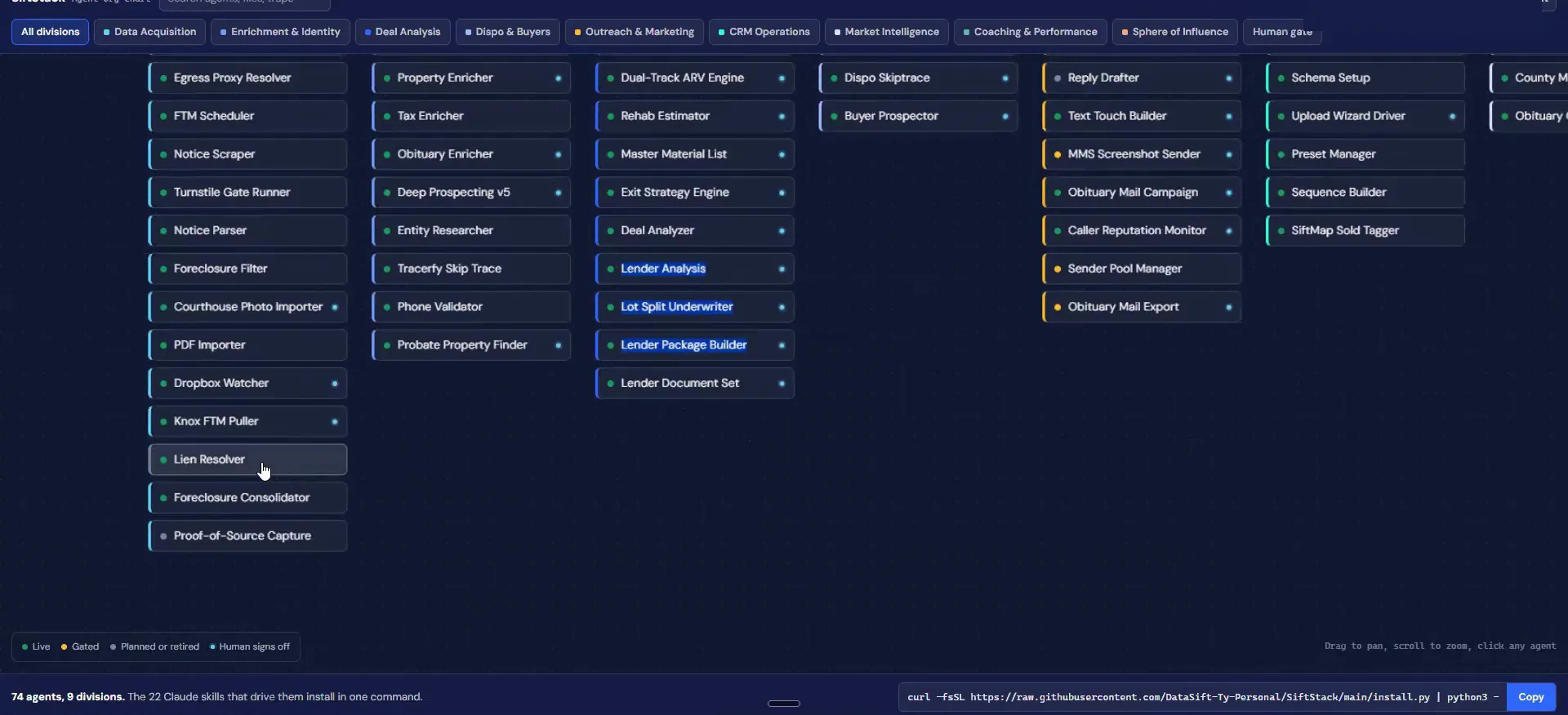
There is a lien resolver in here, and there is another one that checks every property manually. It looks up the individual property on the assessor and tells me the tax delinquent amount.
I had the same problem you have. Take Knox County. You cannot go to the county and ask for a tax delinquent list. They will tell you to pound sand.
What they will give you is the tax auction list. That is the 100 to 500 properties going to auction because they have been delinquent since 2022.
That's the only way that I've found to be able to get around it because I had the same issue that you did.
Ask Claude to look up tax by property address.
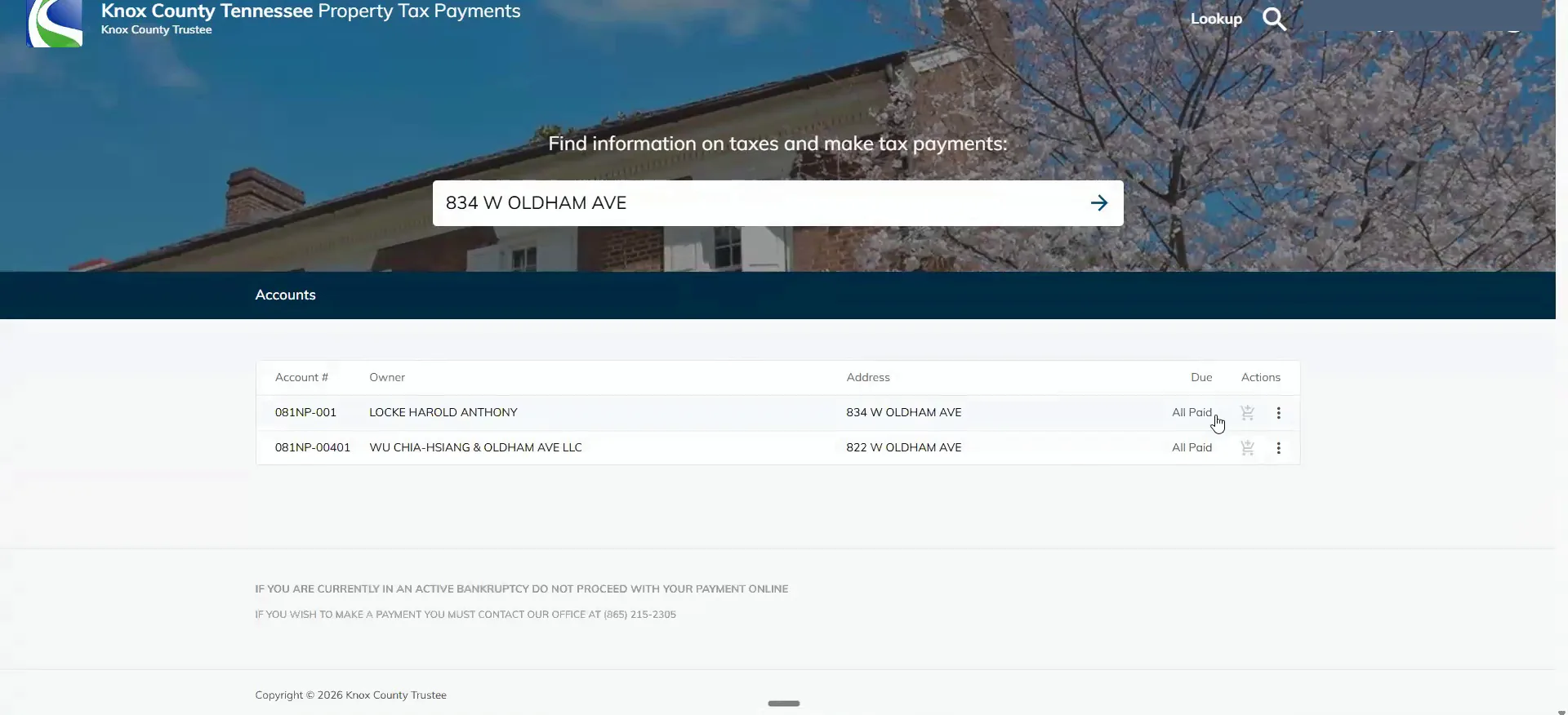
Something along the lines of tax lookup by property address. I go into my account and put in a real one, 834 West Oldham. It pulls up the actual property and tells me their tax delinquency amount on a one off basis.
So you can have Claude run that lookup on all of your properties. That is what I do.
Most counties in The US will have this because there has to be a way for an individual consumer to look up to see what they're actually owed.
Skip the tax filter and hit all the obituary data.
If the lookup is not there for your county, you still have a good option. Hit every property in the obituary flag and you get pretty similar results.
It costs a little more and it saves you the whole tax workaround. Tax data is really difficult for most people here, so I would rather spend the small money.
But at the very least, you could just hit all the obituary data and probably get pretty similar results for, maybe $300 more month.
BEFORE YOU MOVE ON
PART 3
Marketing dollars, overhead, and daily pulls.
Someone asked me at what stage of the business you make the jump to the AI data. I gave the number I use, and then showed what the same market share costs you on the all lists. Then we close with how often to pull and which list sits dead last.
When to jump to the AI data.
Make the jump at 3 to 5,000 a month.
If you are spending between 3 to 5,000 a month, I would start to do it. You also want six months of runway in your marketing dollars. Usually that 3 k plus range is where it starts to really make sense.
For us it makes a ton of sense because we save a lot of money. Tyler is in the 15 to 10 k range as well.
Because, we're spending, $10 a month, 10 to $15 depending on mail campaigns, I do a bunch of split tests and stuff.
When to jump
Market share on half the properties.
Compare market share on the all lists to the AI data.
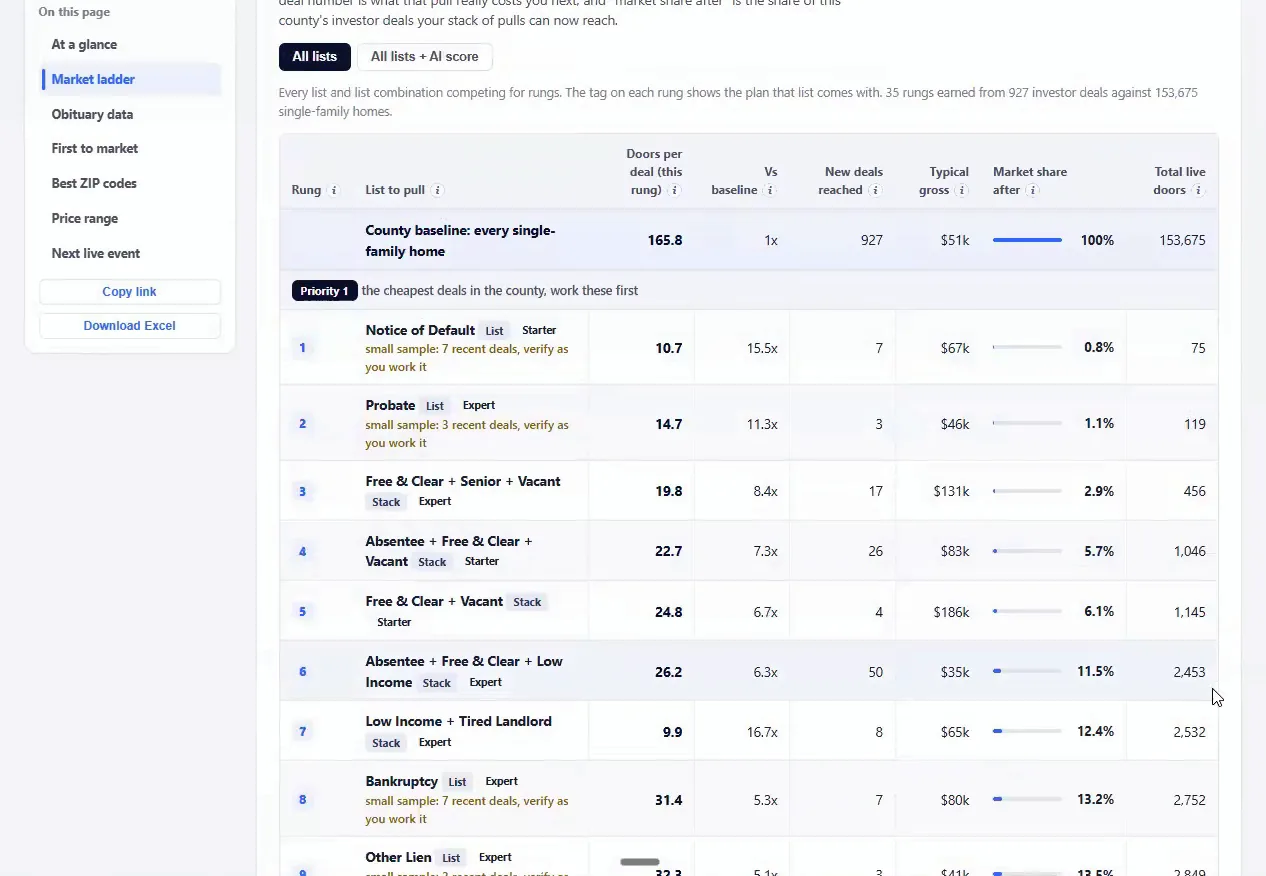
Look at the all lists here. For me to capture 11% market share I am marketing to about double the properties I need.
On the AI data it was 8.3%. I am marketing to about half the properties to get very comparable market share. It is actually more than double on the other side.
Count every channel you run against each record.
I do not have a perfect math equation for you. But for every set of records you add a decent amount of marketing dollars, because we are going so deep.
Think about recall, voicemail, text, emails, door knocking, direct mail. That is the new thing everyone wants to jump on, and we are bolting it onto the next challenge cohort.
When you do all those marketing channels to, a 100 records, if you can shave off, a thousand using the AI data, you'll save a lot of money.
The AI data lowers your overhead.
Pull fewer records for the same result.
The AI data is exclusively designed to lower your overhead with getting the same result. Doing 2,400 when we can just do 1,400 and still get the same amount of market share.
That is the whole trade. Same market share, about half the doors, and every channel you run on those 100 records costs less.
That is hers, she has two that are in the top five, and that shows you the, swing in terms of, it's very hyper localized.
Same result
The same market share on fewer records.
Keep the local swing in mind for the next section.
Hers has two lists in the top five that are nowhere near the top of mine. It is very hyper localized, so do not borrow someone else's order.
The next portion of today is the market analysis side. Neighborhoods versus the ZIP codes we love, all that kind of analysis.
Pull this list every day.
Pull your first to market list every day.
It will pull in every day from SIFT on SiftMap. It will also pull in every day from your first to market, assuming you set it all up correctly with Cloud too.
I am really big into everyday stuff, and I will show you examples of why that matters. Also keep in mind your state. Default is really good in Tennessee, but a judicial state runs a much longer foreclosure clock.
may have a totally different foreclosure process and, may be in a judicial state where it's like a twelve month sales cycle on foreclosures.
Start with vacant and seniors if you want a safe bet.
I always get asked whether there are lists that universally work well. Vacant and seniors do really well right now, and there are all kinds of stats about the amount of boomers retiring.
If I look at hers in Denver, senior, free and clear and vacant is near the top. That is also one of mine.
Leave low equity for last.
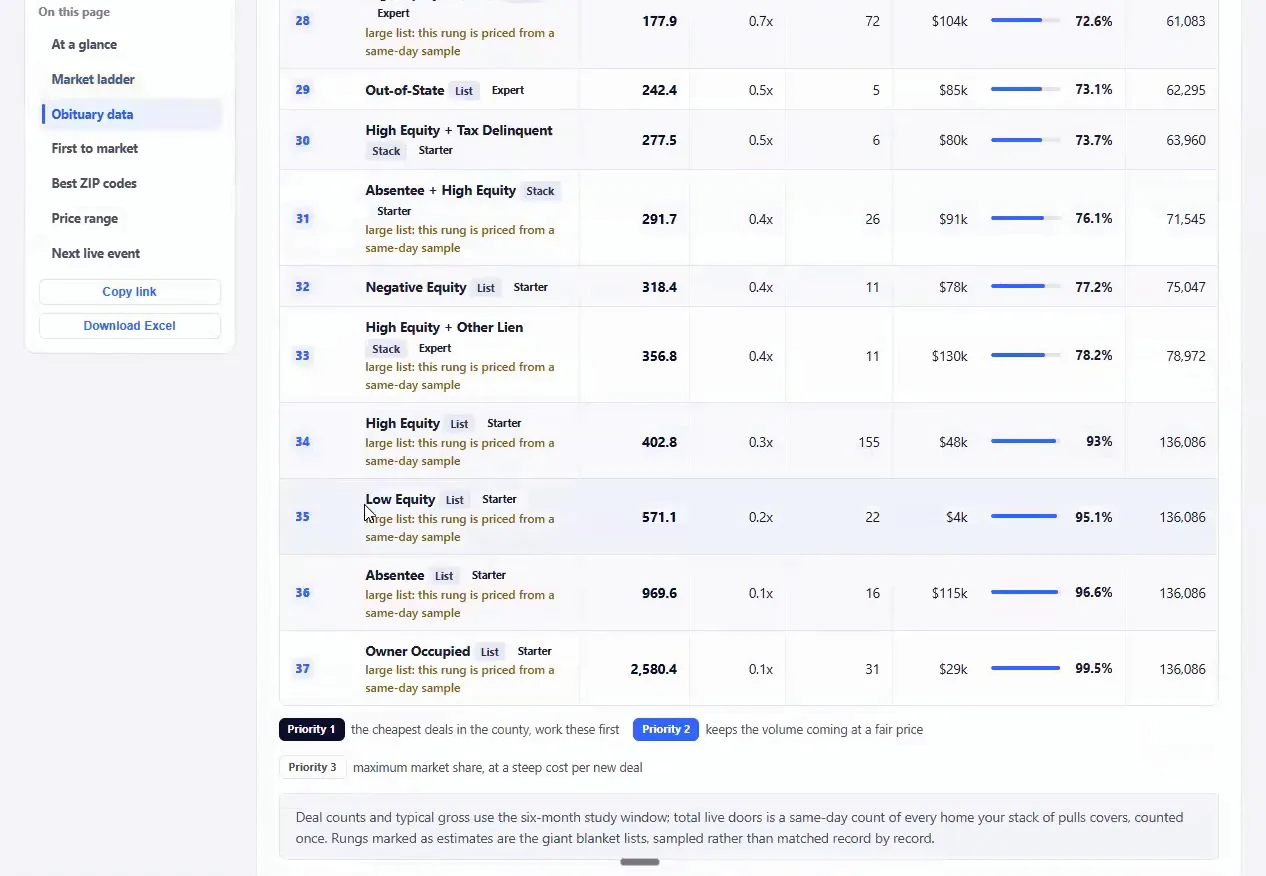
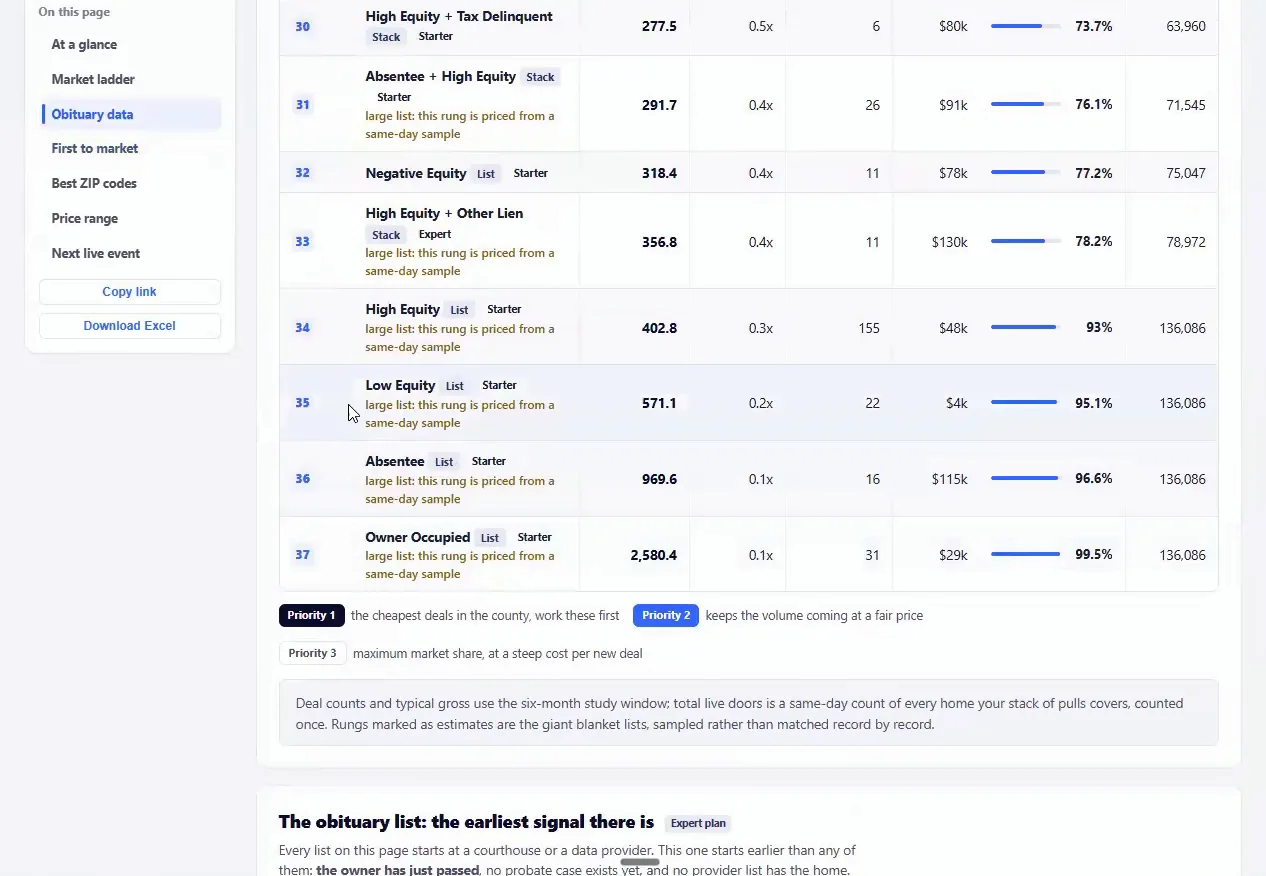
Look at the average deal size on low equity and then look at senior homeowner, free and clear and vacant. The gap is huge. That makes logical sense, because low equity sellers do not have the equity to sell at a discount.
I also designed the system so it will automatically suppress the small deal sizes. There is a reason low equity sits where it sits, and the doors per deal on it are terrible.
But a senior homeowner that has a free and clear house that's also vacant has a lot higher motivation and the deal sizes are much larger.
BEFORE YOU MOVE ON