
PART 1
Order your channels by cost per touch.
Every dollar you spend has a cost per touch. I always go from the cheapest touch to the most expensive, on the same list. This first part covers SMS, cold calling and direct mail.
Start with the cheapest touch.
Line up every channel from cheapest to most expensive.
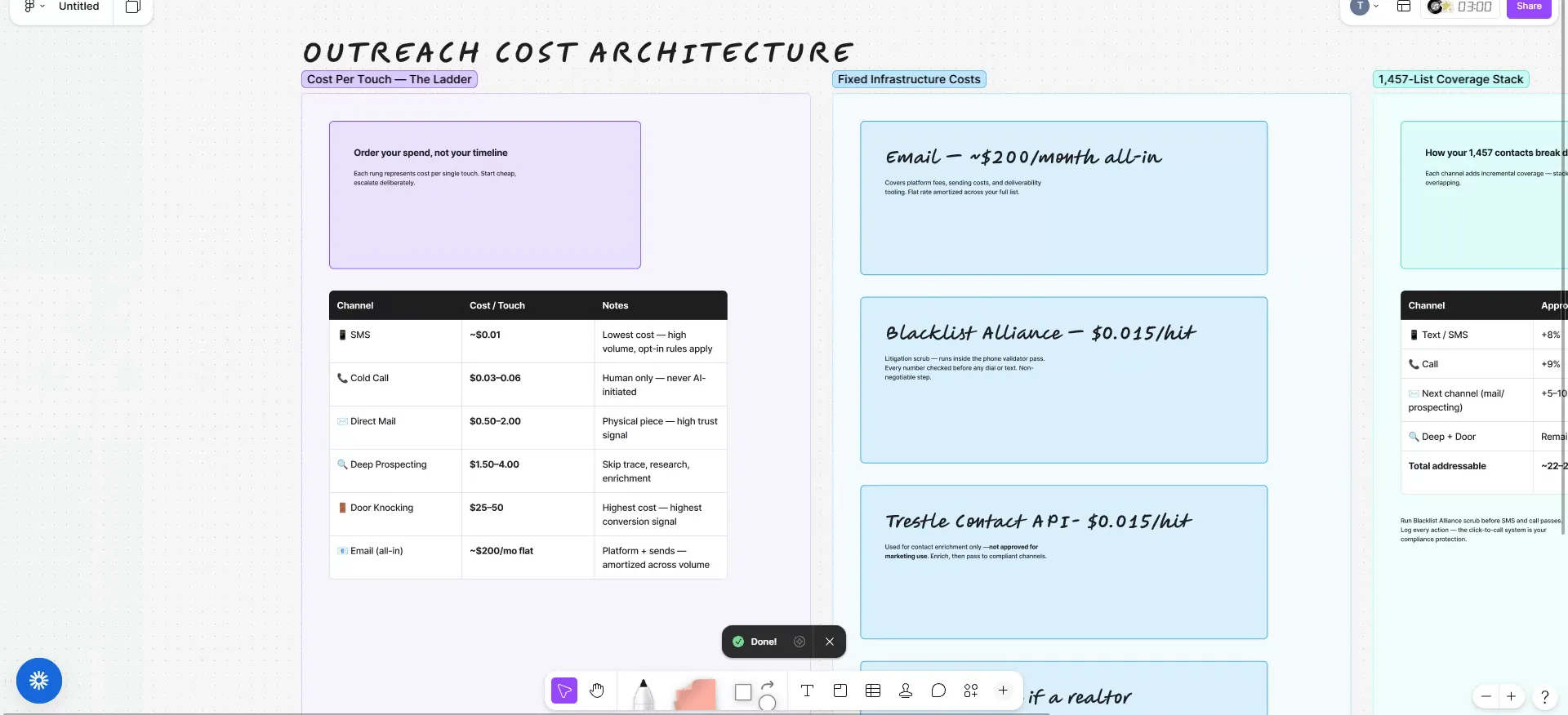
The way I like to do this is I always want to go from the cheapest to the most expensive marketing touch. Everything down that line is a primary channel that I see. Top of the list is SMS, usually through something like SmarterContact, then cold calling.
And all of the different things that you're gonna be seeing kinda down this line here, these are all the different primary channels that I see.
Pick your dialer, click to dial or bulk.
Cold calling has two paths. You can do the click to dial approach, or you can do the bulk dialing approach. Honest answer, it is hit or miss which one is best right now.
The two tools we see performing the best are SmrtPhone and Kixie. They are our best integrations from a one to one perspective. There are some people who love SmrtPhone and some people who love Kixie.
I'm moving over to Kixie because I've been having some issues with SmrtPhone at this current time of September 14 filming this.
Expect us to integrate tools, not build them.
The reason we do not do this from an in house perspective is that this is an ever changing flow. So we integrate with all the tools we think are the best. That way you are never all in on one thing.
If a tool ever has issues, you are way safer from a channel risk perspective. We are all about diversifying risk. You keep certainty and clarity in your marketing workflows.
SMS is cheaper than cold calling.
Budget 3 to 6¢ per touch here.
I typically see a 3 to 6¢ cost range here. The range depends on whether you are doing click to dial or bulk dialing. Click to dial runs more, because with bulk you get through so many more.
With SMS, a lot of automations are coming out that let you do this on your own. That one can go up to 3¢ too. It is always going to be cheaper than cold calling because of the labor portion.
And I'm including the for cold calling specifically, you can you really need that person from a labor perspective to make those dials.
Choose between postcard, check mailer and handwritten mail.
Then we get down into direct mail. You can choose to just use DataSift internally. We use OpenLetter on the back end, so you can go to OpenLetter directly and we do not make any money off of it.
They have some newer templates that we do not have access to. One good example is the soft offer check, which I think they call a snapback check mailer.
There's gonna be an entire direct mail in training on this, but there are really three types of direct mail that we're seeing performing well right now.
Price the check below market value before mailing.
The postcard is the family style one. The soft offer check takes the property value and subtracts it down to 80% of market value. So you send out a check saying we are going to buy this property for $80,000, and maybe the property is worth a 100,000. It looks like a check.
The last one is handwritten mail. It does really well for death related things, because it has that grandma, RSVP, home local feel. Cost totally depends on what you send, and postcards sit at the lower end.
Direct mail
Three types of direct mail are working now.
- 1PostcardThat's kind of family style, and it sits at the lower end of that 50¢.
- 2Soft offer checkYou send a check saying we're gonna buy this property for $80,000 when maybe it's worth a 100,000.
- 3Handwritten mailIt does really well for death related things because of that local, RSVP feel.
BEFORE YOU MOVE ON
PART 2
Handwritten, deep prospecting, door knocking, email.
These are the most expensive touches in the list, and they sit at the bottom for a reason. Handwritten mail, deep prospecting, door knocking, then email at the end. Each one earns its cost a different way.
The handwritten route.
Price handwritten mail higher than your printed mail.
Handwritten sits above the printed stuff on cost per touch. If you go that route, you are in the $2 range. So handwritten goes there in the order.
But if you're going on that kinda handwritten route, that was a terrible circle, a kinda handwritten route that would be more of that $2 range there.
Deep prospect anyone the other channels could not reach.
Deep prospecting is an AI workflow that lets you do a ton of research on one person. There is a module later on that walks through it. It pairs with SmartSkip, which is one of the best skip tracing platforms along with Forewarn.
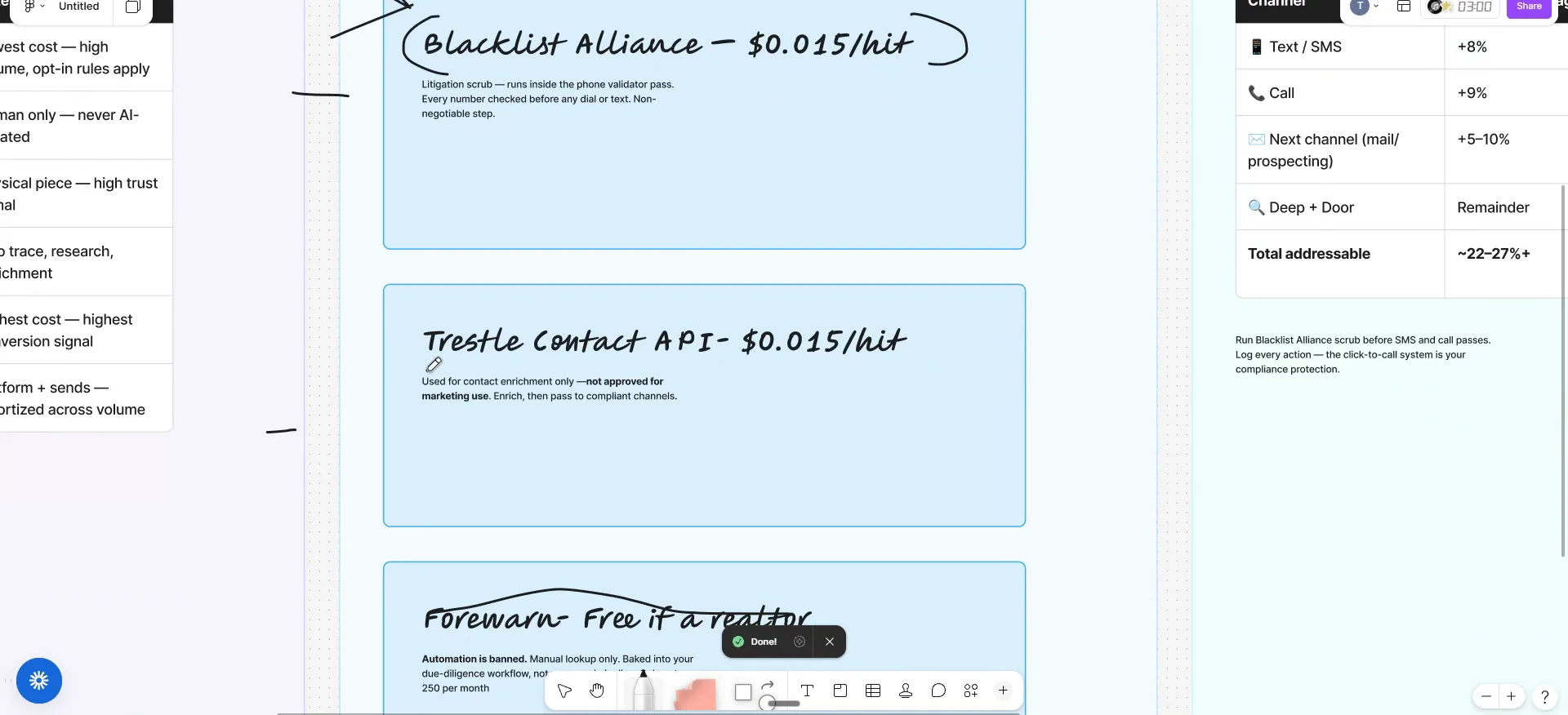
Forewarn needs you to be a licensed agent. You are capped at about a couple hundred per, and you have to be careful not to abuse it or you get banned.
I have it at up to $4 per person, and that has come down some over the last few months. AI is becoming more of a commodity, so it gets cheaper as we go. Where you land depends on the models you are using, and the low end is closer to what it should be now.
And this is something that if you cannot reach someone through SMS, through cold calling, through direct mail, then we want to deep prospect them.
Door knocking and email.
Treat door knocking as your most expensive touch.
It is the most expensive kind of touch you can do, and it works. People bolt it on at the end. If you are just starting out and super bootstrapped, you can start here too.
A friend of mine does just foreclosures in the Midwest.
They have a team of three, and they do about $1.8 million a year just off door knocking, probates, and foreclosures.
Use door knocking on the lists everyone else is mailing.
The sales cycle and saturation module breaks down first to market having a longer cycle with less saturation. Door knocking cuts straight through, no matter how saturated a list is.
Auctions are a good example where you need a much higher quality touch. Keep these things in mind, because it all starts to stack up.
Put email last and let it run on autopilot.
Email is interesting. I have it at the end because the cost is flat per month rather than per touch. We are starting to test it out now, and I have friends who are really doing well with it.
You have to buy domains and use a tool called Instantly, plus some ancillary tools that stack on top. I am going to show you those in a few minutes. Because the cost is flat, you can keep sending to your top records without the meter running.
I have it down here at the end because it's kind of a flat $200 a month.
BEFORE YOU MOVE ON
PART 3
Stack the channels, then add the tools.
The list you built in the ladder is small enough to go all in on. This part is about putting every channel on that same list at once. Then I show you the two tools I would not run without.
Go all in on the top rungs.
Market to the whole top of your ladder.
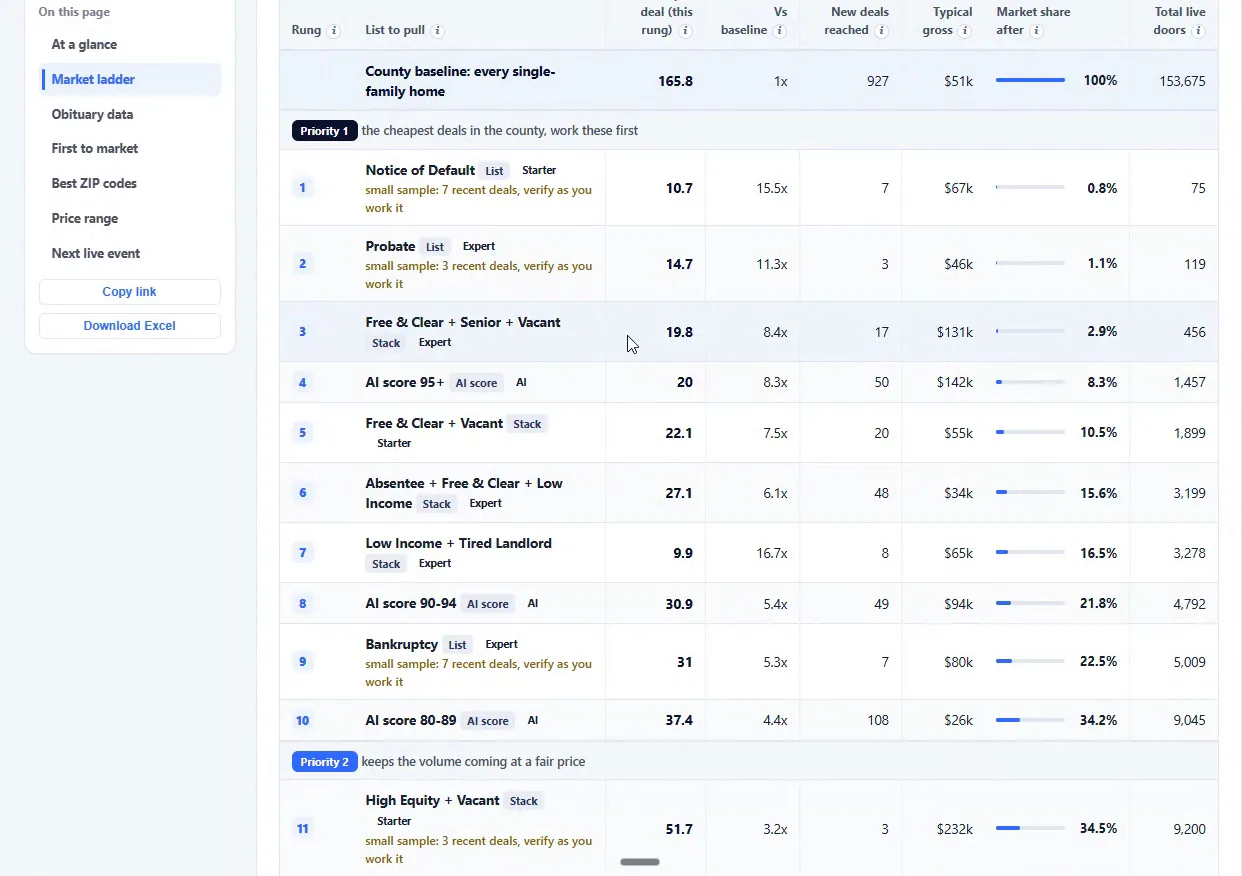
When you spin all these things together and focus on the top doors per deal, this is what makes it powerful. With 1,457 properties in front of me, I know for sure that list yields roughly 77 deals.
I get 77 by adding the 50, the 17, and the two smaller rungs together. I would happily market to those 1,457 properties and go all in on that entire list, because I know the deals are there. For every 20 properties I reach out to, it is going to be a transaction.
And when you spin all these things together and you're focusing on the top doors per deal here, this is what makes it so powerful.
Stack every channel on that same list.
We stack SMS, cold call, direct mail, deep prospecting, door knocking and emailing together. Each channel raises the odds we reach one of these people. It also spreads the risk instead of going all in on one single channel.
We want to reach as many of these people as humanly possible. If we reach every one of them, we monetize the vast majority of those leads. That holds when we have good marketing, good follow up and a good sales process. Then, and only then, do we expand outward.
And then and only then do we expand outward, which is why we build this entire tool for the doors per deal to be exactly like this.
The whole list
The deals are already in the stack.
The fixed cost infrastructures.
Use Trestle to cut the numbers you dial.
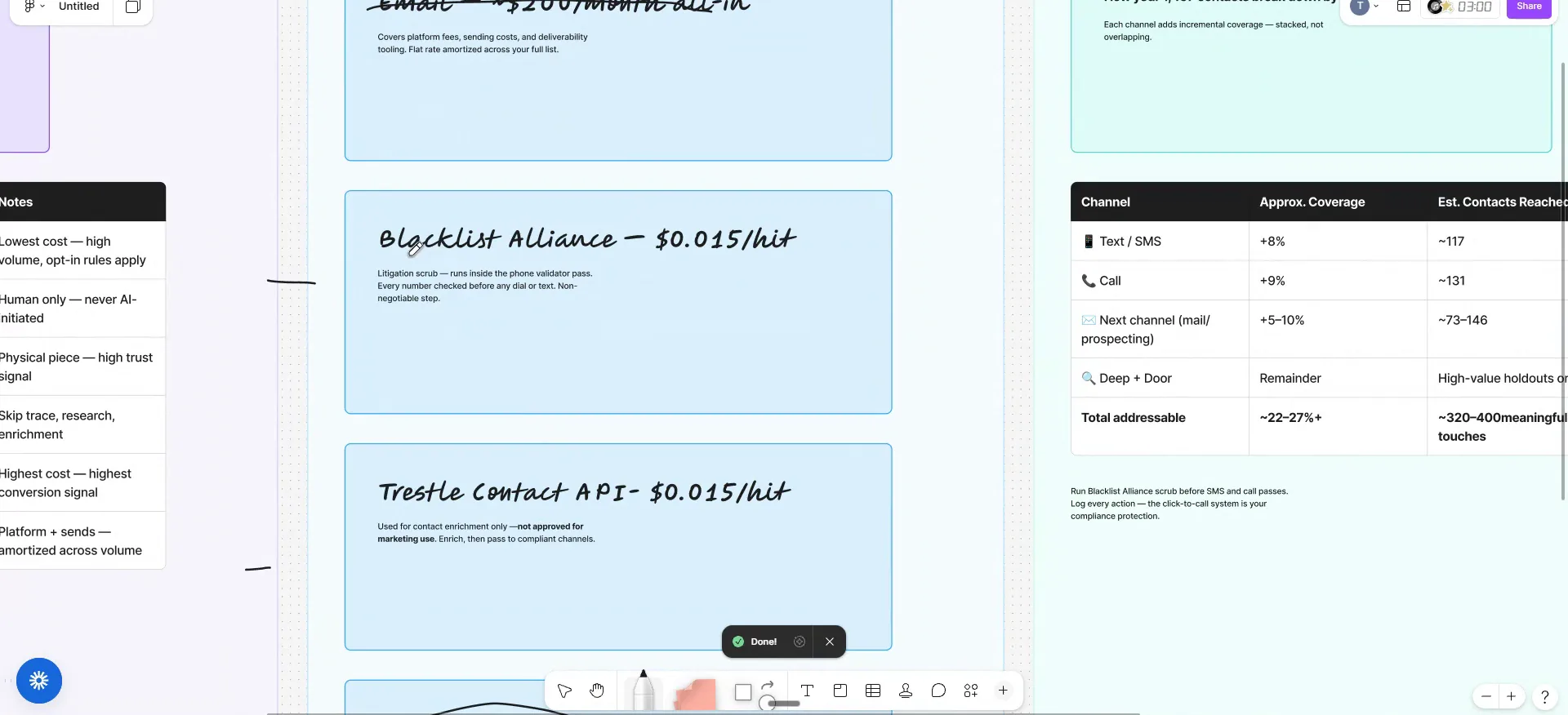
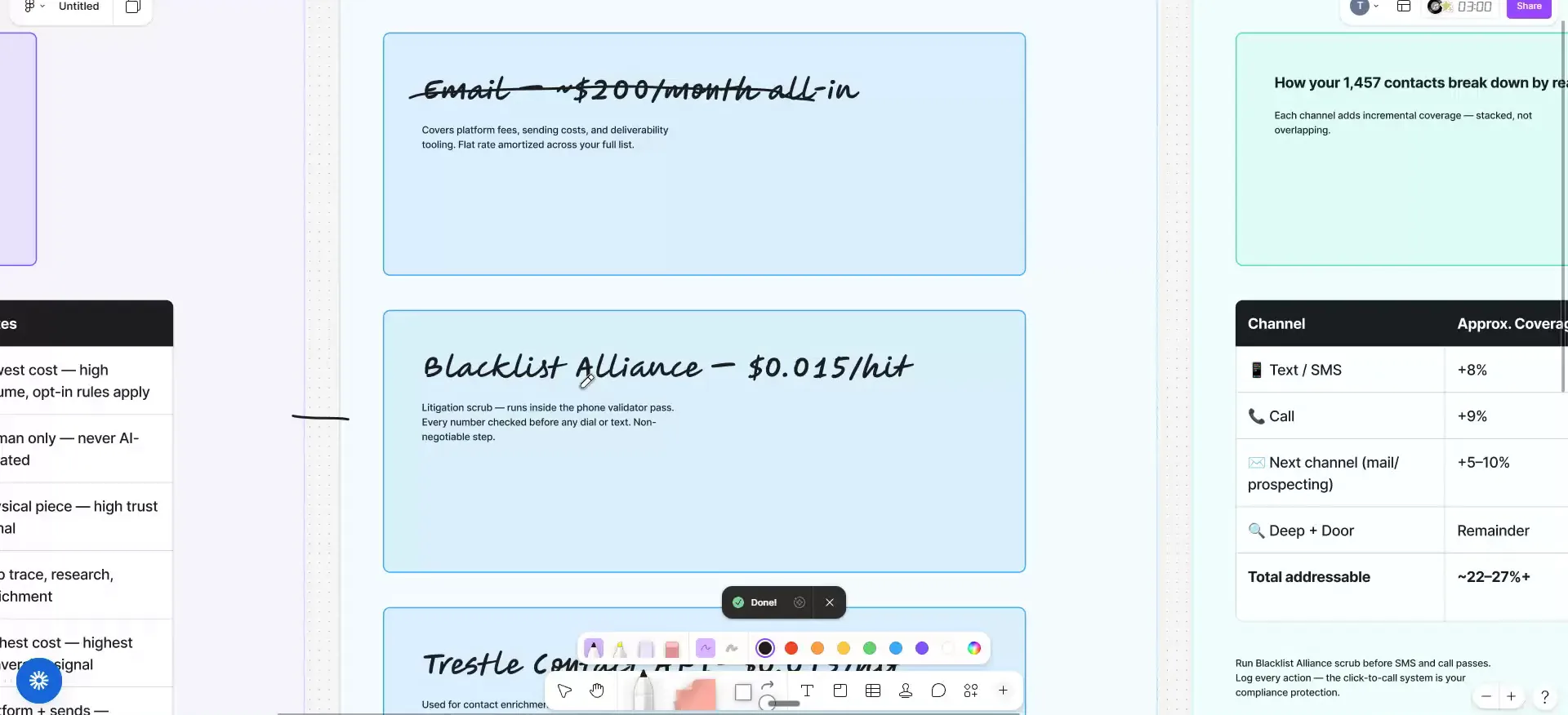
That ladder is a good starting point for all the elements of these channels. There are other tools tied into this whole process, and we call them fixed cost infrastructures. Email is already covered up in the channel list, so I cross that one out here.
Trestle is a way to reduce the amount of numbers you have to reach out to. That applies to SMS, cold call, and even your email flows, because you are reaching far fewer people overall. It costs pennies per hit, and I am paying for a larger team.
These are some of the other tools that are really tied into this entire process, and we call them fixed cost infrastructures.
Skip Forewarn unless you hold a license.
If somebody on one of these high performing lists has a long pile of phone numbers, you do not dial all of them. The Trestle workflow narrows it to the few numbers worth the touch. I am going to show you that workflow in a few minutes. There is a training on it as well.
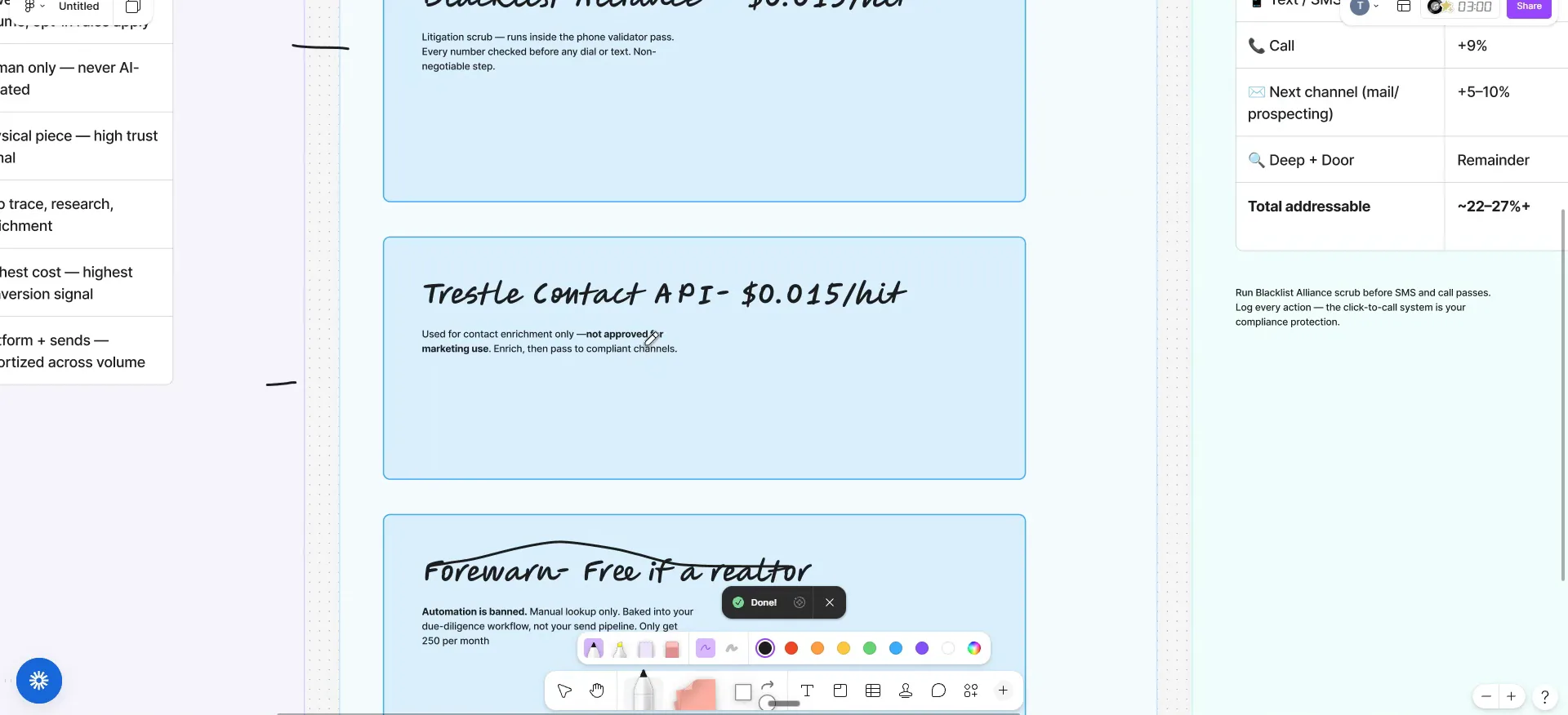
Forewarn is the one I forewarn you about. If you are a realtor, great, get it. If not, mark it out and move on.
I am not an attorney. Get your own legal advice and every disclaimer you can imagine. But if you are not going to do the DNC suppression, please.
BEFORE YOU MOVE ON
PART 4
Order the touches, then stack them.
Every dollar you spend has a cost per touch, and the cheap ones go first. Then you pick the channels that fit the business you actually want. Last piece is running them all on the same list.
Blacklist Alliance suppression is a litigation list.
Run all of your data through Blacklist Alliance suppression.
This is a litigation list. These are all the people that have ever been associated with some type of lawsuit in general. We run all of our data through it.
It's about 1.5¢ per phone number. Any phone number that has a hit come up, we mark that record as a never market to tag. We suppress those records forever and just don't do anything with it.
So make sure you're doing that always. I am not an attorney, so get your own legal advice here.
Enroll the Trestle workflow, then pick one channel.
I would highly recommend enrolling the Trestle workflow as well. When you spend all that together, you can start at just kind of one cost here. Maybe just pick one channel, the one that has the best fit for you.
The main thing is the list. We want the best doors per deal for the list that we want to market to. Maybe it's free and clear, senior homeowner and vacant, and it's only the records I showed earlier.
Then you decide how to reach those records. Based off the kind of business you want, the lifestyle you have, the budget. That's where SMS, cold calling and direct mail come in.
But the main thing is we wanna pick the best doors per deal for the list that we wanna market to.
You can start with direct mail.
Send direct mail and take the calls yourself.
Depending on what kind of business you want, you can do the cold calling and the SMS yourself, or you can hire someone. Or you can just start with mail. Send it out and take the calls as they come in.
Then have a really high quality voice mail. Hey, I'm a local person, I work at a job, I work at this company here. I'll be calling you after my work hours, in this time range, from this number.
Have a really high quality touch like that, and it will work. That's how Tyler actually got started.
Or if you're just working a W2 job and you're, trying to just barely break into this, you can just start with direct mail.
Or go deep prospecting on the hardest records.
You can go that path, or you can go the path of going super deep. You're finding the hardest to reach people. Maybe an obituary record that has two years plus tax delinquent.
Then you deep prospect that entire family tree to do a curative title deal. That's just one example of what deep prospecting looks like.
You can start with door knocking.
Knock the best auction list if sales fits you.
Maybe you're on a super big budget, you like door knocking, and you're a really good person at sales. Then you go start with door knocking the best auction list in your county.
You're knocking 50 doors to 100 doors a month and dropping off stuff there. You'll get very few deals. Five to 10 deals would be small for us, but you can be super bootstrapped and get a ton of success that way.
I say a few deals relative to whatever your goals are, but five to 10 deals would be small for us.
Add every channel to the same best list.
Here is the next version of all this. We pick all the best strategies and the best doors per deal, and we add each one into our marketing. That maximizes the people we get in contact with on our best list.
Maybe we start with an SMS campaign through SmarterContact and reach part of the list. Then we send them through our bulk dialing workflow through Kixie and get more. Then we bolt in direct mail and get more again.
The records we never reached go into the deep prospecting workflow. The ones we still can't reach, we door knock them, then we email them.
And the point is each one of those is gonna increase the contact rate on the entire list, and that's what makes it super powerful.
Stacking channels
Each channel adds contacts to the same list.
- 1SMS through SmarterContactYou start out with an SMS marketing campaign to the list.
- 2Bulk dialing through KixieThen you send the same records through the bulk dialing workflow.
- 3Direct mailThen you bolt in direct mail on top of the calls and texts.
- 4Deep prospectingThe records you never reached go into the deep prospecting workflow.
- 5Door knocking and emailThe people you still could not reach get knocked and emailed.
BEFORE YOU MOVE ON