
PART 1
Squeeze out as many touches as possible.
This lesson is about squeezing every contact out of one list before you spend more per touch. I walk through a real top list, the contacts it produced, and how the channels split. Then I show why you run them together instead of one at a time.
Go cheapest to most expensive.
Squeeze every cheap touch out of the list first.
What we like to do is go from the cheapest to most expensive touches. We try and squeeze out as many as we possibly can.
Say we know there's fifteen hundred records on one list, and every twenty of them are actually gonna sell to an investor. Then we wanna be thinking how can we reach as many of these people as humanly possible.
And there's gonna be some people who always will answer a call. There's gonna be people who always love direct mail. Then there's gonna be people who just only respond to an email that you send them.
So what we like to do is go from the cheapest to most expensive touches and try and squeeze out as many as we possibly can.
The math on one top list.
Read your contacts against the size of the list.
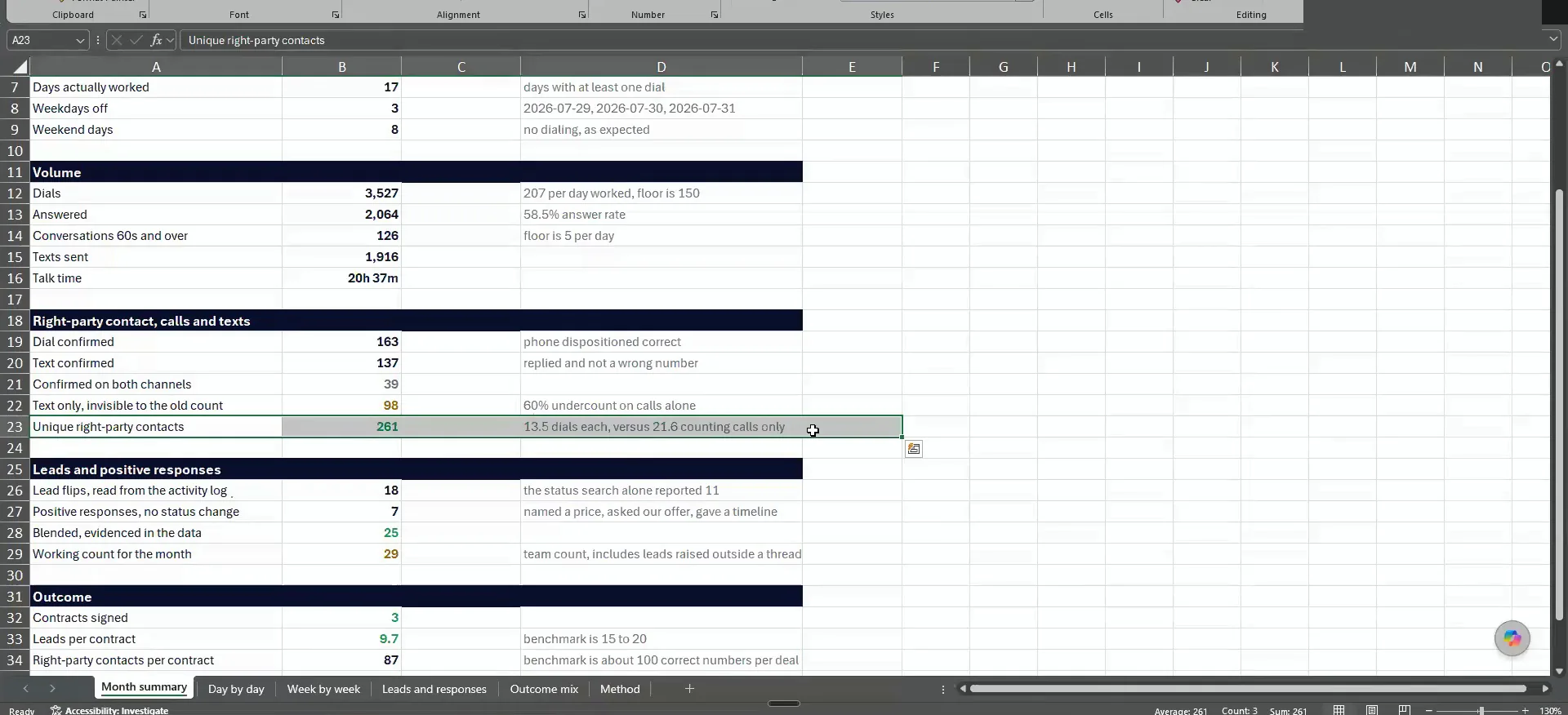
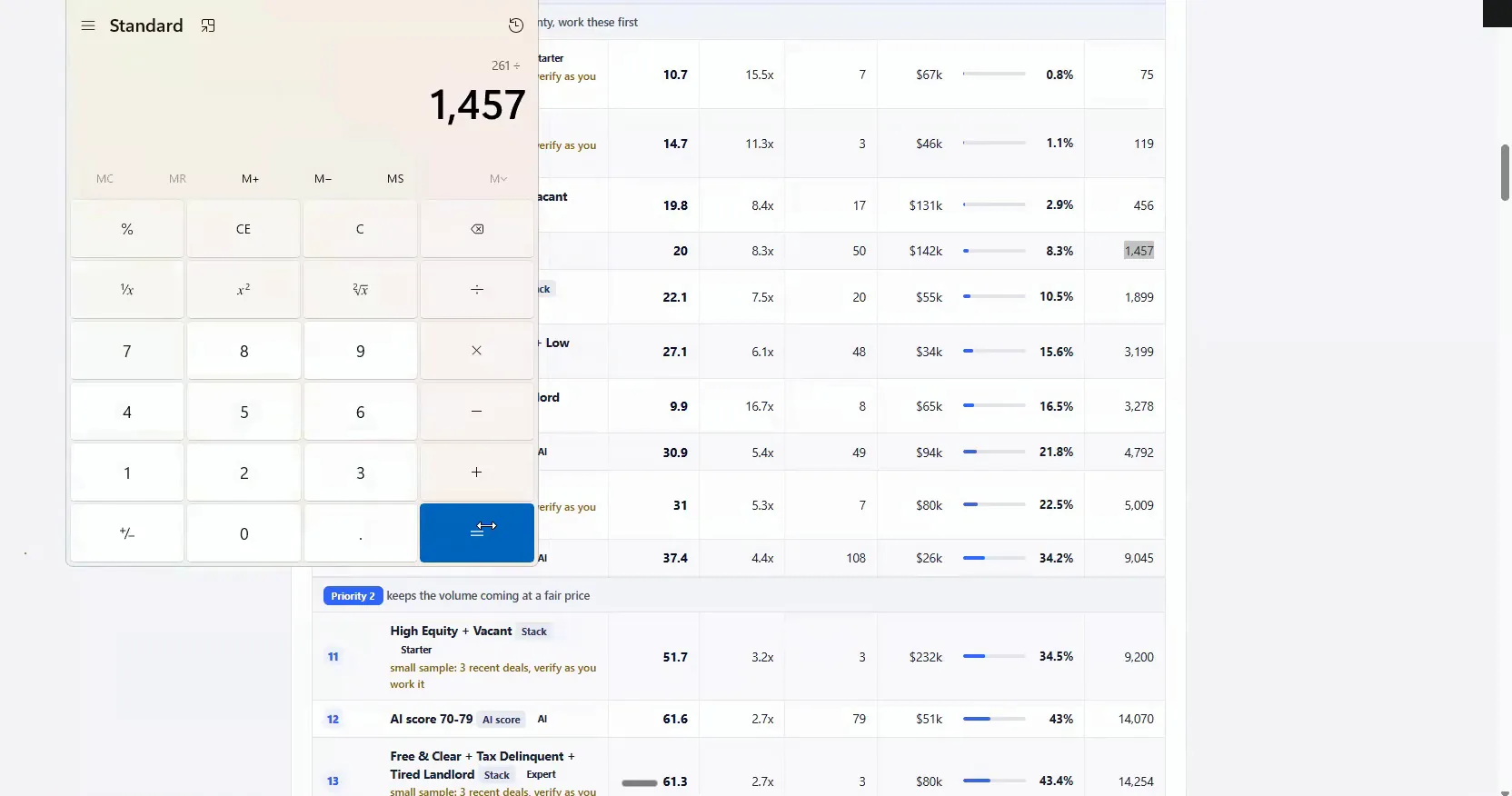
This 261 is a really important number whenever we look at it. Those 261 correct contacts we reached in this month period are all from our top doors per deal. The list itself is 1,457 people.
I know the math can be a little confusing, so stick with me. Open a calculator and take the 261 correct contacts she generated inside the list of 1,457 people. That is the list that sits in my doors per deal framework.
Split those contacts by the channel that produced them.
So we got in contact with 17% of the homeowners on that list. What's pretty interesting is whenever you also look at the distribution here. 163 were dial confirmed versus text confirmed, so it's about eight or 9% from each of these channels.
8% we got through texting, but 9% answered through the call flow. That is why it's so powerful to stack other channels on top. Each one brings its own slice of people.
we're gonna get basically, five to 10% of the correct contacts or leads or people saying they're not interested from each of these channels.
Contact math
One month of contacts on the top list.
About 8% came through texting, and 9% answered through the call flow.
Run texts and calls on the same list in parallel.
Now I'm going to isolate all the people we got in contact with who were either a lead or not interested. The remaining portion, we're going to direct mail them. We're also gonna send email on the front end.
Someone may have higher odds responding to an email versus a text versus a call versus a direct mail piece, or door knocking them. So you do all of it in parallel if you can. Sending out those texts and then calling in the same day is totally acceptable.
This is just a really powerful visual aid. You see the doors per deal, you have total clarity on what you have to reach, and you see how all of those chain together.
BEFORE YOU MOVE ON
PART 2
Cheapest channel first, then stack the rest.
This is solely based on budget. You pick the one channel you can afford, then add the rest on top of the same list. Reaching everyone on a small list beats mass marketing to everybody.
Pick the cheapest channel first.
Run every channel you can on the same list.
In a perfect world we are doing all of it at once. We would have a door knocking team go out, send the direct mail campaign, send the email campaign, send the text, and be calling them.
That is the whole stack of outbound to these 1,457 people. We know every 20 of them is going to be a deal at some point.
in a utopian, we're doing every channel simultaneously because we're going to get in contact with the largest amount of people in the fastest way possible.
Start with the cheapest channel you can afford.
If you are just starting out, pick the channel that suits you. That can just be calling, that can just be texting, or some combination of the two. It could be just emailing if you want. It totally depends.
Do the cheapest one you can afford first and then stack the rest up. The first initial text goes out automatically through the API. When replies come in, a Slack automation notifies the person it is assigned to, and the caller works those calls.
Get 10 numbers for one caller.
We do 25 calls and texts per number. So for one caller, I'll do 10 numbers. That is the starting point, not a ceiling.
You send a mass text to each phone number. From there you filter out which numbers are the real owners, and then you call those.
That's about then you gotta obviously do all this stuff from day two with number verifier, threshold, all that.
Phone numbers
Numbers and touches per caller.
Bulk is not the answer.
Exhaust this list before you extend to the next set.
Bulk is not the answer. The answer is to do every single thing possible to reach this 1,457 people through all of the means I just said. We will have a process for each of those.
Once you have conquered this, then you extend down into the next set, and then the next set, and then the next set. That beats mass marketing to all of them at once.
Once that is exhausted, that is when you introduce inbound. Most people hear it will take them a long time, and there is a place for it too. One thing we are doing is building custom audiences on Meta and Google and targeting these same people.
Not bulk
The answer is to do every single thing possible to reach this 1,457 people through all of the means that I just said. Once you've conquered this, then you'll just extend down into the next set.
Warm up your email sending before you push volume.
People ask if I use an external software like Mailchimp for the email campaigns. You have to warm up, because you do not want to hit straight to spam. I will have an email module next cohort, I promise.
Phil's team did some research on this. You can send a thousand emails a day through Gmail for free without getting marked. They are unique because you are using cloud to do it. So unless you are doing more than a thousand, use Gmail.
Everyone be careful doing that. I have burned a couple of domains that way, so I use instantly and follow a whole process. I have damaged domains in the past on our flagship stuff before.
I put this in the deal room, but there's a group that I learned from that I know a lot of people are getting success with.
BEFORE YOU MOVE ON